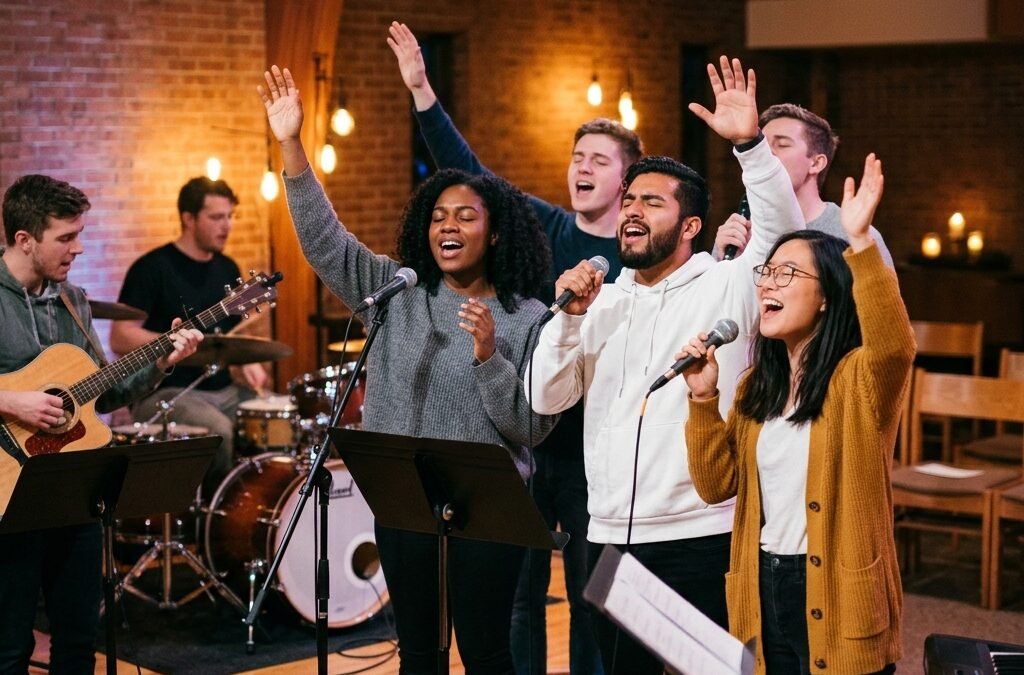
There is a moment most believers know: a song comes on, and something in the chest loosens. Words you have tried to pray but could not quite form are suddenly being sung back to you, and you realize you are not alone in the struggle. Music does something to us that argument alone cannot. It reaches past the intellect and lands in the marrow. This is not a modern discovery—it is ancient, biblical, and deeply human.
Every summer, Brett McCracken of The Gospel Coalition releases a curated list of artists making music that is both musically excellent and unapologetically Christian. His 2026 edition, featuring fifteen artists from three continents spanning rock, folk, pop, lo-fi, hip hop, and EDM, is a reminder that the global church is singing—and singing with growing creativity and conviction. Read the source article to explore the full list and its accompanying playlist. But the list itself is an invitation to ask a deeper question: Why does music matter so much to the life of faith, and what should we be listening for?
The Human Condition: We Were Made to Sing, and We Forgot the Song
Scripture is clear that human beings were created for worship. We were made to orient our whole selves—mind, will, emotion, body—toward God. But the fall fractured that orientation at every level. Sin did not merely make us morally guilty; it disordered our loves. We began worshipping the creature rather than the Creator, filling the God-shaped space in our souls with noise, distraction, and lesser beauties.
“For although they knew God, they did not honor him as God or give thanks to him, but they became futile in their thinking, and their foolish hearts were darkened.” — Romans 1:21
The darkness Paul describes is not merely intellectual. It is doxological—a failure of praise. We were built to glorify God, and when we stopped, something broke in us that we have been trying to fill ever since. The music industry, in all its brilliance and excess, is in many ways humanity’s restless attempt to recover what was lost: transcendence, meaning, beauty, belonging. The hunger is real. The diagnosis, however, requires Scripture to name it properly. As Jeremiah observed, “The heart is deceitful above all things, and desperately sick” (Jeremiah 17:9). We reach for beauty but often grasp at counterfeits. We long for songs that tell the truth, but we are drawn to songs that flatter.
Christ: The Word Made Flesh Who Gives Us New Songs
The gospel does not merely add a moral layer to our music listening. It changes the very ground on which we stand when we open our mouths to sing. Jesus Christ, the eternal Word through whom all things were made (John 1:3), entered creation as a human being, lived the life of perfect worship we could not live, and went to the cross to bear the penalty for our disordered loves and broken praise. His resurrection is the first note of a new creation—a cosmos being restored to its proper song.
“He put a new song in my mouth, a song of praise to our God. Many will see and fear, and put their trust in the LORD.” — Psalm 40:3
This is not poetic decoration. The psalmist is describing a genuine transformation: the person who has been rescued from the pit (Psalm 40:2) now has something true and glorious to sing about. The gospel is the content of the new song. When artists like Joel Figueroa set Romans 8:26—the Spirit interceding for us with groanings too deep for words—to music, or when Franni Cash writes about the saving power of Jesus in “Jesus All Along,” they are doing something theologically serious: they are translating the doctrines of grace into the language of the heart. Paul commands the church to address one another in “psalms and hymns and spiritual songs, singing and making melody to the Lord with your heart” (Ephesians 5:19). Music is not an accessory to discipleship. It is one of its primary vehicles.
The incarnation also sanctifies artistic diversity. Jesus entered a specific culture, spoke a specific language, wore specific clothes. He did not arrive as a generic human. In the same way, the gospel does not demand a single musical style. That fifteen artists from three continents—from Brisbane folk trio Rothbury to San Diego hip-hop artist Jon Keith to London poet-pastor Joshua Luke Smith—are all making music rooted in Scripture is itself a sign of the Spirit’s work across the whole earth. The diversity is not a compromise of the message; it is a demonstration of its reach.
Living It Out: Becoming Intentional Listeners
If music shapes the soul, then what we listen to is a discipleship question. Here are three practical ways to let this truth change your playlist and your life:
1. Listen with Theological Ears
Ask of every song: What does this teach me about God, myself, and the world? Music that is lyrically rich—songs rooted in Scripture, honest about suffering, and anchored in Christ—will form you differently than music that merely makes you feel good. The Apostle Paul urges believers to think on whatever is true, honorable, just, pure, lovely, and commendable (Philippians 4:8). This is a filter for the mind, and it applies to what we allow to play on repeat.
2. Use Music as a Gateway to Scripture
When a song moves you, trace it back to its source. Joel Figueroa’s “Groanings” is inspired by Romans 8:26—go read the whole chapter. Stillcreek’s songs about Psalm 119 are invitations to sit with the longest chapter in the Bible and let it wash over you. Let music be a door, not a destination. The Word of God is living and active (Hebrews 4:12), and a great song can make you hungry for it.
3. Sing Together, Not Just Alone
The New Testament commands corporate singing. Colossians 3:16 says, “Let the word of Christ dwell in you richly, teaching and admonishing one another in all wisdom, singing psalms and hymns and spiritual songs, with thankfulness in your hearts to God.” The “one another” is not incidental. Music is meant to be a communal act of worship and mutual encouragement. Share what you are listening to with your small group, your family, your church. The artists on McCracken’s list are not just for personal playlists—they are resources for the whole body.
The Gospel: The Song Beneath Every Song
Every faithful piece of Christian music is, at its root, a variation on one theme: we were lost, and we have been found. We were dead, and we have been made alive. We were enemies of God, and through the blood of Jesus Christ shed on the cross and the power of His bodily resurrection, we have been reconciled to the Father.
“But God shows his love for us in that while we were still sinners, Christ died for us.” — Romans 5:8
This is the song that does not grow old. It is the melody underneath every honest lyric about church hurt, every desperate prayer set to a techno beat, every folk harmony rising from a living room in Brisbane. The artists making music today who are doing it well are not inventing a new message—they are finding new ways to sing the oldest and truest one.
If you do not yet know this song personally—if you have never trusted Christ as your Savior and Lord—then the music is an invitation. The door is open. Jesus said, “I am the resurrection and the life. Whoever believes in me, though he die, yet shall he live” (John 11:25). Repent of your sin, trust in His finished work, and discover that He has been preparing a new song for you all along. That song is the beginning of a life that does not end.