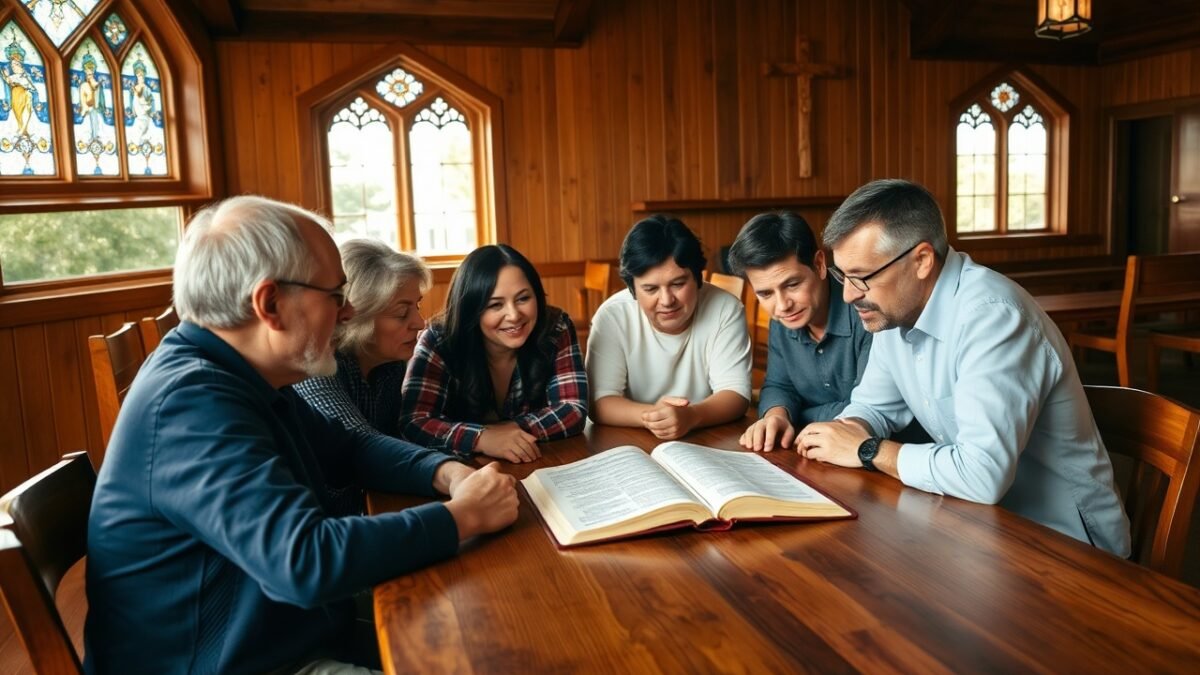
There is a quiet ache in the modern Christian experience that few dare to name aloud: the sense of being spiritually stuck. We attend services, consume sermons online, follow faith influencers, and yet something essential feels absent. Growth—real, rooted, fruit-bearing growth—remains elusive. The Apostle Paul diagnosed this condition nearly two thousand years ago, and his prescription is as countercultural today as it was in first-century Corinth. Read the source article from Tabletalk Magazine for a rich exploration of this passage.
A Field, a Building, a Temple: Paul’s Vision of the Church
The Bible is saturated with agricultural imagery. Isaiah sings of a vineyard that yields only wild grapes and is given over to destruction (Isa. 5:1–7). The psalmist pictures the righteous man as “a tree planted by streams of water that yields its fruit in its season” (Ps. 1:3). Jesus speaks of sowers and soil, wheat and tares, and declares Himself the true vine whose branches must abide in Him to bear fruit (John 15:5). Each image carries the same insistent message: life in God is not static. It grows—or it withers.
Into this rich tradition, Paul plants a striking metaphor in his first letter to the Corinthians. “You are God’s field, God’s building,” he writes (1 Cor. 3:9). The church is not merely an organization or a weekly gathering. It is a living plot of ground that belongs to God, tended by His servants, and dependent entirely on Him for its increase. This image is not decorative. It is diagnostic.
The Diagnosis: Immaturity, Division, and a Self-Centered Gospel
Before Paul reaches the agricultural metaphor, he levels a sobering charge at the Corinthian believers. They are, he says, still infants in Christ—people who require milk because they cannot yet digest solid food (1 Cor. 3:1–2). Their spiritual immaturity is not hidden; it is visible in the fractures running through their community. Factions have formed around personalities: “‘I follow Paul,’ or ‘I follow Apollos,’ or ‘I follow Cephas,’ or ‘I follow Christ'” (1 Cor. 1:12). Celebrity culture had colonized the church.
“For while there is jealousy and strife among you, are you not of the flesh and behaving only in a human way?” — 1 Corinthians 3:3 (ESV)
This is not merely an ancient problem. Much of contemporary evangelical Christianity has drifted toward a consumerist spirituality—one in which individuals remain connected to a church only as long as it satisfies personal preferences. Churches, in turn, often design their ministries around attracting particular demographics rather than forming mature disciples. The result, as Paul warned, is a field full of stunted plants: Christians who profess faith but remain perpetually dependent on elementary teaching, never advancing toward the “solid food” that produces endurance, discernment, and Christlikeness (Heb. 5:14).
Scripture is clear about the root of this condition. The human heart, left to itself, curves inward. “The heart is deceitful above all things, and desperately sick” (Jer. 17:9). We are by nature “children of wrath” (Eph. 2:3), prone to fashion God in our own image and to treat His church as a service provider rather than a covenant community. This is not pessimism—it is the honest biblical diagnosis that makes the gospel necessary and glorious.
Christ at the Center: The Cross Reorients Everything
Paul’s remedy for the Corinthians’ immaturity is not a better leadership model or a more sophisticated program. It is the cross. Before he ever reaches chapter 3, he has already declared that he resolved “to know nothing among you except Jesus Christ and him crucified” (1 Cor. 2:2). The cross demolishes every human hierarchy of wisdom and status. It announces that no personality, no preacher, no platform can save—only the death of God incarnate on behalf of sinners.
“For the word of the cross is folly to those who are perishing, but to us who are being saved it is the power of God.” — 1 Corinthians 1:18 (ESV)
The resurrection seals what the cross accomplished. Christ did not remain in the tomb. He rose bodily on the third day, defeating death and inaugurating a new creation (1 Cor. 15:20–22). This means that every believer who is united to Him by faith is already a new creature (2 Cor. 5:17)—not a finished product, but a living seed placed in God’s field, destined for growth. The risen Christ is not a distant figure to be admired from afar. He is the vine; we are the branches. Apart from Him, we can do nothing (John 15:5). In Him, we bear fruit that lasts.
Notably, in the twenty-three verses of 1 Corinthians 3, Paul makes twenty-one references to God, Christ, or the Holy Spirit. The Christian life is, at its core, a God-centered life—not a self-improvement project, not a spiritual consumer experience, but a daily dying to self and living to Christ (Gal. 2:20).
How the Field Grows: Ordinary Means, Extraordinary Power
Paul describes the mechanics of growth with disarming simplicity: “I planted, Apollos watered, but God gave the growth” (1 Cor. 3:6). Both Paul and Apollos accomplished their work the same way—by preaching and teaching the Word of God. These are what theologians call the ordinary means of grace: the proclaimed Word, prayer, and the sacraments. They are ordinary in that they are unremarkable to the eye. They are extraordinary in that God Himself works through them to transform souls.
The Reformer John Calvin captured this beautifully when he wrote of the church as the mother into whose bosom God gathers His children, nurturing them “until they mature and at last reach the goal of faith.” The Apostle Paul echoes this when he insists that it is only together “with all the saints” that believers will be able to “comprehend with all the saints what is the breadth and length and height and depth” of Christ’s love (Eph. 3:18). Growth in grace is inherently communal. It cannot be downloaded, streamed, or consumed in isolation.
Living It Out: Rooting Yourself in God’s Field
What does it look like, practically, to take Paul’s agricultural vision seriously? Consider three commitments:
- Commit to a local church with depth. Seek a congregation committed to the whole counsel of God—one that moves believers beyond elementary teaching toward the mature food of Scripture. The writer of Hebrews warns that perpetual infancy carries the danger of drifting from the faith altogether (Heb. 6:4–8). Your church home is not a preference; it is a spiritual necessity.
- Be a doer, not merely a hearer. James warns that the one who hears the Word without obeying it is “like a man who looks intently at his natural face in a mirror” and immediately forgets what he saw (James 1:23–24). Receiving the Word joyfully, meditating on it, and faithfully putting it into practice is the soil condition that allows growth to happen.
- Examine the world’s influence on your mind. The Corinthians were stunted because they continued to embrace the world’s triumphalist, human-centered philosophy. Paul’s call is to be “transformed by the renewal of your mind” (Rom. 12:2)—to think critically about how cultural assumptions shape your attitudes toward church, community, and self.
The Gospel: The Seed That Makes the Field Possible
Every field begins with a seed. The seed that makes God’s field possible is the gospel itself: that we are sinners, separated from God by our rebellion, utterly unable to save ourselves. That God, in His infinite mercy, sent His Son Jesus Christ—fully God and fully man—to live the life we could not live, die the death we deserved, and rise from the dead on the third day, conquering sin and death on our behalf. That this salvation is received not by effort or achievement, but by grace alone, through faith alone, in Christ alone (Eph. 2:8–9).
“But to all who did receive him, who believed in his name, he gave the right to become children of God.” — John 1:12 (ESV)
If you have never placed your trust in Christ, today is the day of salvation (2 Cor. 6:2). Repent of your sin, believe in the risen Lord Jesus, and be planted in His field. If you are already a believer, do not remain a seedling. Sink your roots deep into the community of God’s people, receive the nourishment of His Word, and trust that the same God who raised Jesus from the dead is at work in you—giving the growth, season by season, until the harvest comes.