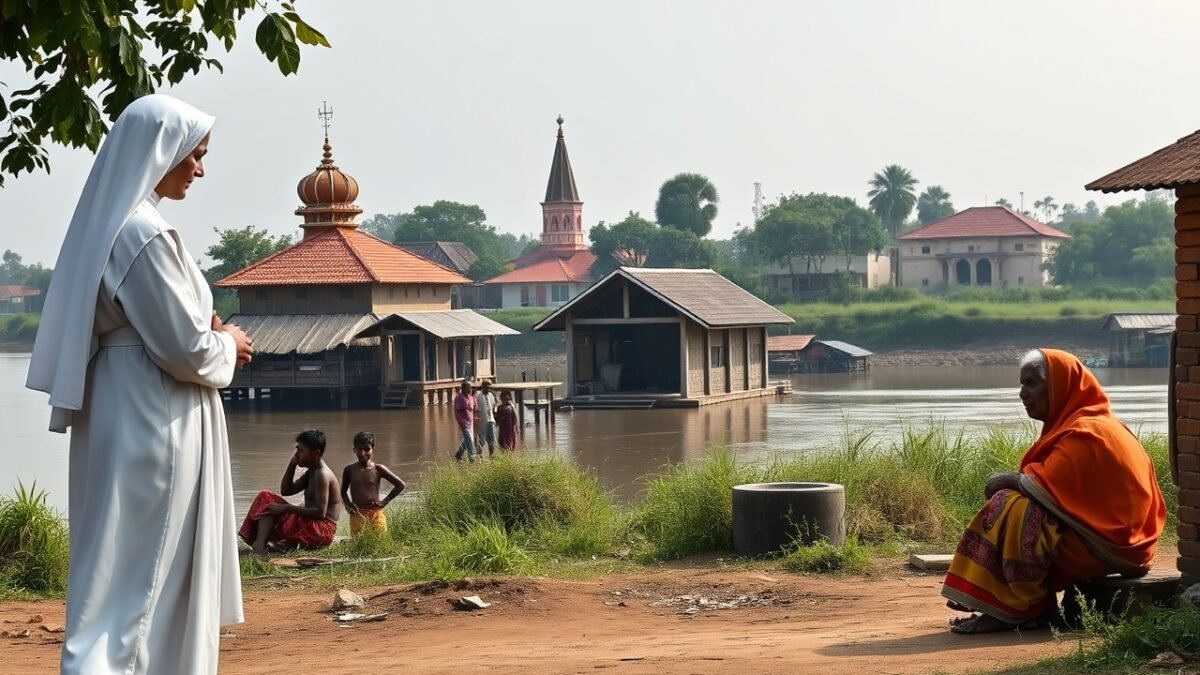
Every human heart carries the same restless ache. It does not matter whether a person was raised in a Hindu household in West Bengal, a Muslim neighborhood in Kolkata, or a church in the American Midwest. Something deep within us reaches outward—toward the sacred, toward protection, toward a power greater than our own frailty. Augustine named it in the fourth century: “Our heart is restless, until it repose in Thee.” Scripture names it even earlier: “He has made everything beautiful in its time. He has also set eternity in the human heart” (Ecclesiastes 3:11).
A remarkable scene unfolding on the banks of the Hooghly River in eastern India makes this ache visible. At the Basilica of the Holy Rosary in Bandel—a 16th-century Catholic church built by Portuguese Augustinian friars—thousands of pilgrims gather each year. The majority are not Christian. They are Hindu and Muslim men and women who travel to venerate a statue of the Virgin Mary, to write prayer intentions on slips of paper, and to seek what one pilgrim called simply “community and peace.” Read the source article. The scene is striking, and it deserves a thoughtful, gospel-centered response—not scorn, but honest compassion rooted in Scripture.
The Diagnosis: A Longing That Cannot Be Self-Cured
What draws a devout Hindu woman to a Catholic basilica week after week for thirteen years? What pulls Muslim sailors to pray before a statue of Mary for safe voyage? The answer is not theological confusion alone—it is theological hunger. Human beings were made for God, and when that connection is broken, we do not stop seeking; we redirect our seeking toward whatever seems most likely to answer us.
“The heart is deceitful above all things, and desperately sick; who can understand it?” (Jeremiah 17:9)
Scripture is unflinching about the human condition. We are not merely confused seekers who need better information. We are fallen image-bearers whose moral and spiritual compass is bent inward by sin (Romans 3:23). Left to ourselves, we construct mediators—shrines, rituals, sacred objects, holy figures—because we sense, rightly, that we need something outside ourselves to bridge the gap between our weakness and the divine. The tragedy is not that people seek. The tragedy is that the most beautiful human seeking, apart from Christ, circles endlessly without arriving (Romans 1:21–23). Paul describes this pattern in Athens as well as Bengal: people who are “in every way very religious” (Acts 17:22) and yet do not know the God who made them and is “not far from each one of us” (Acts 17:27).
The pilgrims at Bandel are not villains. They are neighbors—neighbors whose longing for protection, peace, and a divine mother-figure reveals exactly the wound that the gospel was designed to heal.
The Answer: One Mediator, Fully Known
Here is where the Christian message must be spoken clearly, charitably, and without apology. Mary of Nazareth was a remarkable woman—chosen by God, full of grace, the mother of our Lord (Luke 1:28, 42). She is honored in Scripture. But she is not a mediator. She is not a protector of sailors. She is not the “primordial force in the universe.” She is a redeemed human being who herself needed a Savior (Luke 1:47). To assign to her the role that belongs to Christ alone is to misread both her story and His.
“For there is one God, and there is one mediator between God and men, the man Christ Jesus, who gave himself as a ransom for all” (1 Timothy 2:5–6).
This is not a sectarian talking point. It is the hinge of the entire New Testament. Jesus does not point toward a mediator—He is the mediator. He does not recommend a shrine—He calls Himself the door (John 10:9), the way (John 14:6), the living water (John 4:10). When the woman at the well asked about the right mountain for worship, Jesus redirected her entirely: worship is not about geography or sacred objects, but about spirit and truth, and it flows from knowing the Father through Him (John 4:21–24). The crowds at Bandel are asking the right questions—Where can I find protection? Where can I find peace? Where is the power that can hold my life together?—and Jesus answers every one of them, not from a statue, but from a cross and an empty tomb.
The resurrection is the decisive fact. Mary’s statue was reportedly rescued from the Hooghly River, and that legend has sustained devotion for centuries. But Jesus Christ was raised from the dead by the glory of the Father (Romans 6:4), and that is not legend—it is the most attested event of the ancient world, witnessed by hundreds (1 Corinthians 15:3–8), and it changes everything. A rescued statue cannot forgive sin. A risen Savior can.
Living It Out: What the Church at Bandel Teaches Disciples Everywhere
Even as we hold firmly to the exclusive claims of Christ, the scene at Bandel carries genuine lessons for every follower of Jesus.
1. Recognize the Longing Before You Answer It
The nuns serving at Bandel—offering counseling, education for underprivileged girls, healthcare, and spiritual support to Hindu and Muslim families alike—demonstrate something apostolic: presence before proclamation. Paul reasoned in the synagogue and the marketplace (Acts 17:17). He observed before he spoke. Christians who want to share the gospel with people of other faiths must first earn the right to be heard by genuinely caring for the person in front of them. “Walk in wisdom toward outsiders, making the best use of the time” (Colossians 4:5).
2. Pray for the Persecuted Church in India
Reports document 831 attacks against Christians in India in a single year, including a mob that vandalized a newly constructed church south of Kolkata just days ago. The early church was told to remember those who are mistreated “as though in prison with them” (Hebrews 13:3). This is not an abstract command. It means interceding specifically, giving generously to organizations supporting persecuted believers, and speaking truthfully about what is happening. Suffering is not a footnote to the Christian story—it is woven through it (2 Timothy 3:12).
3. Distinguish Admiration for Mary from Misdirected Devotion
Christians can honor Mary’s obedience, her courage, and her unique role in salvation history without elevating her beyond what Scripture warrants. When we speak with Catholic neighbors or with people drawn to Marian devotion, we do so with respect—acknowledging what is true and beautiful—while gently pointing toward the One she herself pointed toward: “Do whatever he tells you” (John 2:5). That is the most Marian thing any Christian can say.
4. Be a Witness Where You Are
You may never visit Bandel. But you live near people whose hearts carry the same restless ache as Rimpa Chowdhury’s. The gospel is not a program—it is a person, and every believer has been entrusted with His name (Acts 1:8). Ask God today for one conversation with someone who is seeking.
The Gospel: The Only Voyage Worth Taking
The statue at Bandel is called “Our Lady of Happy Voyage.” Sailors have prayed before it for centuries, asking for safe passage across dangerous waters. The image is beautiful in its honesty: all of us are voyagers. All of us face waters that can swallow us. All of us need something more than our own navigation.
The gospel declares that God did not send a statue. He sent His Son. Jesus Christ, fully God and fully man, lived the life we could not live, died the death we deserved, and rose on the third day to open a way through the deepest waters of all—sin, death, and judgment. “For Christ also suffered once for sins, the righteous for the unrighteous, that he might bring us to God” (1 Peter 3:18). This is the happy voyage: not a journey toward a shrine, but a journey toward the Father, made possible only through the Son, sealed by the Spirit.
If you have never placed your trust in Jesus Christ, the invitation stands open today. Not to a religion, not to a statue, not to a set of rules—but to a Person who knows your name, bore your guilt, and conquered your grave. Repent of your sin. Trust in Him alone. And discover that the restlessness Augustine described was always meant to end here, in Him, where it finally does.