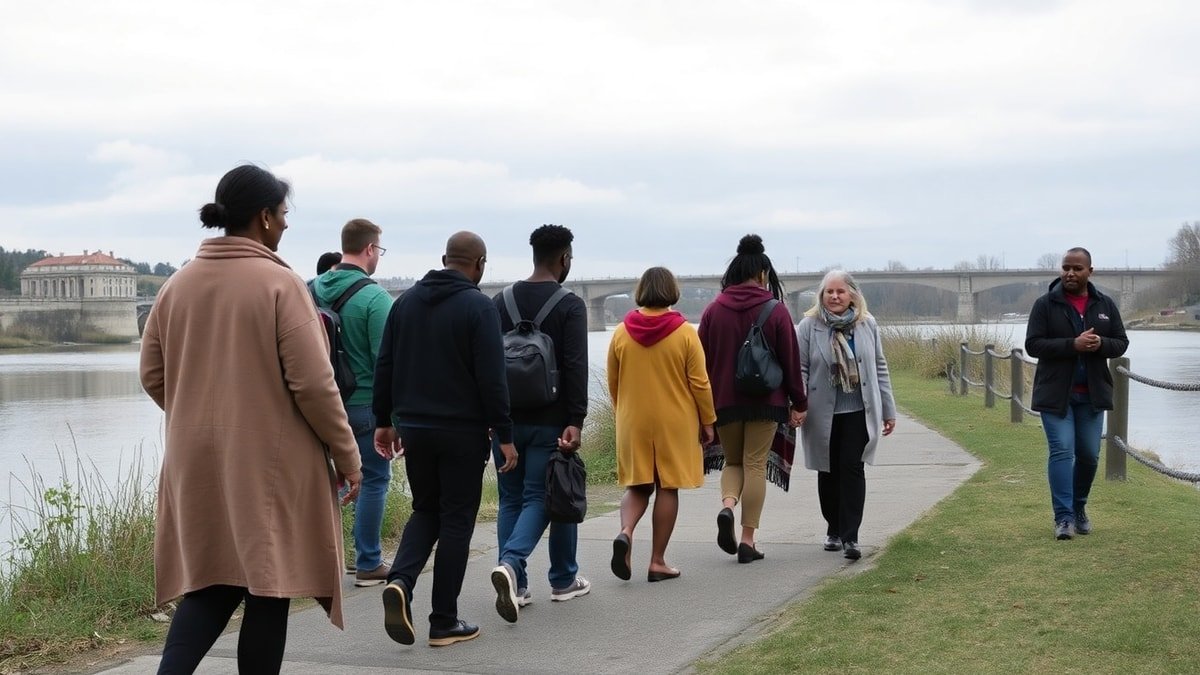
There is a muddy trail in Richmond, Virginia, that remembers what many would rather forget. From 1830 to 1860, tens of thousands of enslaved men, women, and children were shackled together and forced to walk it — from the Manchester Docks to the auction house where they were sold as property. The trail has not forgotten them. And increasingly, neither has the Church.
On June 13, 2026, about twenty Virginians walked that trail in silence. Some held onto one another. A gospel singer performed Wade in the Water beside them. One woman, Renee Munford, wept. “Every time I looked out at the water, all I could see was people coming in on ships and disembarking, and just in a frenzy,” she said. “So my heart bled for that.” Read the source article. The walk was the opening act of a daylong pilgrimage called “Walking With the Enslaved: The Church’s Role in Slavery,” organized by two Richmond Episcopal congregations — St. Paul’s, once attended by Robert E. Lee and Jefferson Davis, and St. Philip’s, one of the South’s oldest Black Episcopal churches, founded in 1861 by enslaved and freed Richmonders.
This pilgrimage raises questions that go far deeper than history or denomination. They are questions the whole Church must sit with: What does genuine repentance look like? What does Scripture say about the sin of dehumanization? And how does the gospel — not sentiment, not social momentum, but the actual gospel of Jesus Christ — call the Body of Christ to reckon with the wounds it has both suffered and inflicted?
What Scripture Says About the Sin Behind the Wound
The institution of chattel slavery as practiced in American history was not a neutral social arrangement. It was a systematic denial of the image of God — the imago Dei — stamped on every human being at creation. Genesis 1:27 declares without qualification: “So God created man in his own image, in the image of God he created him; male and female he created them.” To buy, sell, and brutalize a human being is to desecrate what God has declared sacred. The sin is not merely historical; it is theological.
“There is neither Jew nor Greek, there is neither slave nor free, there is no male and female, for you are all one in Christ Jesus.” — Galatians 3:28 (ESV)
The Apostle Paul’s declaration to the Galatians was not merely aspirational poetry. It was a subversive announcement about the new humanity Christ was creating — one that obliterates every hierarchy the fallen world erects to justify the domination of one person over another. When the Church in Richmond’s antebellum era sat in its pews, sang its hymns, and then returned home to its plantations, it was not merely guilty of hypocrisy. It was guilty of proclaiming a truncated gospel — one that saved souls for heaven while leaving bodies in chains. The prophet Amos thundered against exactly this kind of religion: “I hate, I despise your feasts, and I take no delight in your solemn assemblies… But let justice roll down like waters, and righteousness like an ever-flowing stream” (Amos 5:21, 24).
Romans 3:23 reminds us that “all have sinned and fall short of the glory of God.” The doctrine of original sin does not excuse the specific sins of specific institutions — it explains the depth from which those sins arise, and the depth of grace required to address them. The Church that participated in slavery did not do so despite being Christian. It did so because it allowed the surrounding culture to interpret Scripture rather than allowing Scripture to interpret the culture. That is a failure of discipleship with generational consequences.
How Christ Answers the Wound
The good news is not that history can be undone. It cannot. The good news is that Jesus Christ entered history — including its most brutal chapters — and is making all things new. The writer of Ephesians describes what Christ accomplished on the cross in terms that speak directly to the fractures of race and enmity:
“For he himself is our peace, who has made us both one and has broken down in his flesh the dividing wall of hostility… that he might create in himself one new man in place of the two, so making peace, and might reconcile us both to God in one body through the cross, thereby killing the hostility.” — Ephesians 2:14–16 (ESV)
The cross is not merely the place where individual sins are forgiven. It is the place where the dividing wall — every wall of hostility, contempt, and dehumanization — is demolished. The “one new man” Paul describes is not a metaphor for polite coexistence. It is a new creation, a new humanity, forged in the body of Christ and made possible only by his death and resurrection. This is why the pilgrimage in Richmond, whatever its denominational context, points toward something the gospel has always demanded: that the Church be the place where the hostility dies, where the wound is named, and where healing begins — not through pretending the past did not happen, but through the costly, Spirit-led work of truth-telling and reconciliation.
The prophet Isaiah, quoted by Jesus himself at the outset of his ministry, declared: “He has sent me to bind up the brokenhearted, to proclaim liberty to the captives” (Isaiah 61:1). Jesus did not merely spiritualize this text. He embodied it. And he calls his Church to embody it still.
Living It Out: What the Gospel Requires of Us Now
The Richmond pilgrimage is not a template every church must copy. But the spiritual posture it models — honest memory, embodied repentance, cross-cultural fellowship, and prayerful lament — is thoroughly biblical. Here is what that looks like in practice:
- Name the sin honestly. The Church cannot repent of what it refuses to acknowledge. Lamentations 3:40 calls us: “Let us test and examine our ways, and return to the Lord.” Honest examination of our institutional histories — however uncomfortable — is an act of faithfulness, not self-flagellation.
- Pursue cross-cultural fellowship deliberately. The partnership between St. Paul’s and St. Philip’s — a predominantly white congregation and a historically Black one — did not happen by accident. It required intentionality, humility, and a willingness to be corrected. Philippians 2:3 instructs us to “in humility count others more significant than yourselves.” This is not a suggestion for the spiritually advanced. It is the baseline of Christian community.
- Let lament be part of your worship. The spirituals sung on the Richmond trail — Amazing Grace, Take My Hand, Precious Lord — were not incidental. They were theology in motion. The Psalms model a faith that brings grief, anger, and confusion before God rather than suppressing them. Psalm 34:18 promises: “The Lord is near to the brokenhearted and saves the crushed in spirit.”
- Let history inform discipleship. The Rev. Brent Melton, after walking the trail, went home and rewrote his Sunday sermon. He told his congregation that “the work of the Kingdom coming near” requires building communities — even with strangers. That is discipleship. History, honestly encountered, is a teacher the Spirit uses.
The Gospel That Holds All of This Together
Every human being who walked that Richmond trail in chains bore the image of God. Every person who sold them bore it too — and in their sin, they defaced it in themselves and in those they enslaved. This is the human condition: we are image-bearers who have turned against one another and against our Creator. “For all have sinned and fall short of the glory of God” (Romans 3:23). The wages of that sin — personal and collective — is death (Romans 6:23).
But God did not leave us in that condition. He sent his Son, Jesus Christ, fully God and fully human, who lived without sin, died on the cross bearing the full weight of human guilt — including the guilt of those who used his name to justify bondage — and rose bodily from the dead on the third day. His resurrection is the declaration that death, sin, and every system built on the dehumanization of others does not get the final word. He does.
“If we confess our sins, he is faithful and just to forgive us our sins and to cleanse us from all unrighteousness.” — 1 John 1:9 (ESV)
The invitation of the gospel is open to every person who has ever walked a trail of suffering — and to every person who, knowingly or unknowingly, benefited from one. Repent. Believe. Be made new. And then, together, build the kind of community that makes the watching world ask: What holds these people together? The answer is the same it has always been: the cross of Jesus Christ, and the empty tomb that followed.
The trail in Richmond remembers. The gospel redeems. And the Church — when it is truly the Church — does both.