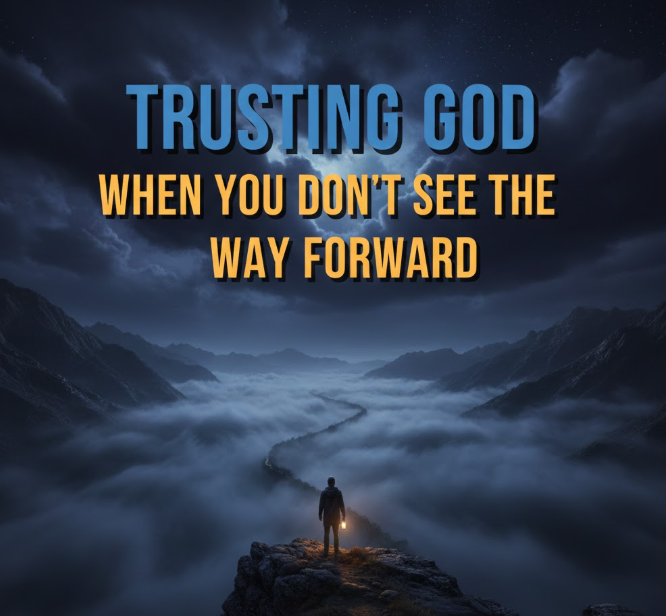
Life doesn’t always come with a roadmap. Sometimes you wake up and realize you have no idea what comes next. The job you wanted falls through. A relationship ends unexpectedly. Health issues shake your foundation. Your carefully laid plans crumble like sand castles at high tide.
During these foggy seasons, trusting God feels less like walking confidently and more like crawling through darkness. You want answers. You want clarity. You want the comfort of knowing what tomorrow holds.
But what if not seeing the path is exactly where God wants you?
This article explores how to build unshakeable trust in God when your future looks like a giant question mark. You’ll discover why uncertainty isn’t punishment but opportunity, and how to take your next step even when you can’t see where the path leads.
Why God Sometimes Hides the Path
Many people assume that if God loves them, He’ll show them exactly what’s coming. They expect detailed directions, like a GPS giving turn-by-turn instructions for life.
But God often works differently.
Think about learning to ride a bike. At first, your parent holds the seat, giving you balance and confidence. But eventually, they let go. Not because they stopped caring, but because falling and catching yourself builds real skill.
God hides the full path for several powerful reasons:
To build genuine faith: If you could see everything ahead, you wouldn’t need faith. You’d simply follow the visible steps. Faith grows in the gaps between what you know and what you can’t see.
To keep you dependent: When you see the whole journey, pride creeps in. You start thinking you’ve got this handled. Uncertainty keeps you humble and connected to God’s strength instead of relying only on yourself.
To protect you from future worries: Imagine if God showed you every hardship coming in the next ten years. You’d be crushed before those challenges even arrived. He reveals things in bite-sized pieces you can actually handle.
To surprise you with His creativity: God’s solutions often look nothing like what you’d plan. When He hides the path, He’s preparing something better than you could design yourself.
The Problem With Needing to See Everything
Our culture trains us to demand control. We want five-year plans, backup plans, and backup plans for our backup plans. Uncertainty feels like failure.
This obsession with seeing ahead creates several problems:
You miss the present moment while obsessing about tomorrow. Your kids are growing up, but you’re too worried about their college fund to enjoy them now. Your friendships fade because you’re always strategizing your next career move.
You waste energy on things outside your control. You can’t predict every outcome, yet you exhaust yourself trying. It’s like attempting to hold water in your bare hands—the tighter you squeeze, the more slips away.
You start trusting yourself more than God. When you demand to see the plan, you’re essentially telling God you don’t trust His leadership. You want Him to submit His strategy for your approval first.
You become paralyzed by fear. Without certainty, you freeze. You don’t apply for that opportunity because you can’t guarantee success. You don’t start that conversation because you can’t predict how it ends.
What Faith Really Means
Faith gets misunderstood constantly. People think it means believing really hard that everything will work out exactly as they hope. They treat it like positive thinking with prayer added.
Real faith looks different.
Faith means trusting God’s character even when circumstances look terrible. It’s believing He’s good when your bank account says otherwise. It’s trusting He has a plan when your relationships are falling apart.
The Bible puts it simply: “Faith is confidence in what we hope for and assurance about what we do not see” (Hebrews 11:1). Notice it doesn’t say faith is seeing the future clearly. It’s being confident in what you can’t see yet.
Think of faith like boarding an airplane. You don’t demand to see the pilot’s license, inspect the engine, or review the flight plan. You trust the airline’s track record. You board the plane even though you can’t see what happens at 30,000 feet.
Trusting God works the same way. You don’t need to see His entire plan. You need to know His character—that He’s always been faithful, always kept His promises, and always worked things together for good.
Historical Examples of Blind Trust
Throughout history, people have trusted God without seeing the full picture. Their stories light the way when your path feels dark.
Abraham’s Journey: God told Abraham to leave his home and go to “a land I will show you.” No address. No map. No arrival date. Just pack up and start walking. Abraham spent his entire life not seeing the fulfillment of God’s biggest promise—that his descendants would outnumber the stars. Yet he kept trusting.
Moses at the Red Sea: Trapped between Pharaoh’s army and an impossible water barrier, Moses had zero solutions. The people panicked. Moses couldn’t see any way forward. Then God split the sea in a way nobody could have predicted or planned.
Joseph in Prison: Falsely accused and forgotten, Joseph spent years in an Egyptian dungeon. He couldn’t see how slavery and imprisonment could possibly lead anywhere good. Yet those exact circumstances positioned him to save nations from famine.
Ruth’s Gamble: After losing her husband, Ruth followed her mother-in-law to a foreign country where she had no connections, no job prospects, and no husband in a culture where women needed marriage to survive. She couldn’t see that picking up leftover grain in fields would lead to remarriage and becoming an ancestor of Jesus.
These people didn’t have crystal balls. They had faith despite the fog.
Practical Steps When You Can’t See Ahead
Trusting God in uncertainty isn’t passive. It requires active choices. Here are practical ways to build that trust:
Focus on the Next Right Step
Stop obsessing about step 47 when you haven’t taken step 2 yet. God rarely shows you the whole staircase. He illuminates just the next step.
Ask yourself: “What’s the one thing I can do today?” Maybe it’s updating your resume. Maybe it’s having a difficult conversation. Maybe it’s simply getting out of bed when depression says to stay under the covers.
Take that one step. Then ask again tomorrow.
Remember Past Faithfulness
Your history with God is evidence for your future. When doubt creeps in, review the times He came through before.
Create a “faithfulness journal.” Write down specific instances when God provided, protected, or guided you. When you worked through that impossible situation. When money appeared just in time. When that door closed but a better one opened.
Reread these entries when your current circumstances feel hopeless. Your past is proof that God doesn’t abandon you.
Stay Connected to Community
Isolation magnifies fear. When you’re alone with your thoughts, worst-case scenarios multiply like rabbits.
Stay connected to people who know God’s character. Their faith can carry you when yours feels weak. They’ll remind you of truth when your emotions scream lies.
Join a small group. Call that friend who always points you back to God. Don’t pretend everything’s fine when it’s not.
Keep Your Spiritual Habits
When life gets chaotic, spiritual disciplines usually go first. You’re too stressed to pray, too busy to read Scripture, too exhausted to worship.
That’s exactly when you need these habits most.
Think of spiritual practices like eating. You don’t skip meals because you’re stressed—stress is when your body needs fuel most. Similarly, uncertainty is when your spirit needs God’s presence most urgently.
Even five minutes of prayer matters. Even one verse of Scripture helps. Keep showing up.
Replace Worry With Gratitude
Worry and gratitude can’t occupy your mind simultaneously. They’re like oil and water—they don’t mix.
When anxiety about tomorrow starts spiraling, interrupt it with thanks for today. List three specific things you’re grateful for right now. Not generic “I’m blessed” statements, but concrete gifts: the coffee that’s still hot, the friend who texted encouragement, the sunshine breaking through clouds.
Gratitude rewires your brain from scarcity thinking to abundance thinking.
The Difference Between Trusting and Being Irresponsible
Some people confuse trusting God with being lazy or reckless. They think faith means sitting on the couch waiting for miracles while ignoring obvious action steps.
That’s not trust—that’s presumption.
Trusting God doesn’t mean:
- Ignoring practical wisdom
- Making foolish financial decisions and calling it faith
- Refusing medical treatment and demanding God heal you
- Avoiding hard work because “God will provide”
Real trust looks like doing your part while depending on God for His part. You apply for jobs while trusting God to open the right door. You study for the exam while trusting God with the results. You pursue healing through medicine while trusting God as your ultimate healer.
Faith and action work together, not against each other.
What to Do When Trust Feels Impossible
Some days, trust feels beyond your reach. The gap between “I should trust God” and “I actually do trust God” feels impossibly wide.
That’s okay. Honest struggle is better than fake certainty.
When trust feels impossible:
Pray honest prayers: Tell God exactly how you feel. “I’m terrified.” “I don’t understand.” “This feels unbearable.” God can handle your raw emotions. He’d rather have your honesty than your religious performance.
Remember it’s a process: Trust isn’t a switch you flip once. It’s a muscle you build through repeated exercise. Some days you’ll feel strong. Other days you’ll feel weak. Both are normal.
Ask for help: Even Jesus’ disciples said, “Increase our faith!” Asking God to help you trust Him better is itself an act of trust.
Give yourself grace: You don’t have to manufacture perfect faith. God isn’t grading your trust level like a test. He sees your heart and meets you where you are.
The Gift Hidden in Uncertainty
Here’s a perspective shift that changes everything: What if not seeing ahead is actually a gift?
When you don’t know what’s coming, you get:
Freedom from anxiety about the future: You can’t worry about what you don’t know. When God hides the path, He’s protecting you from carrying tomorrow’s burdens today.
Deeper intimacy with God: Dependence creates closeness. When everything’s going smoothly, prayer becomes an afterthought. Uncertainty drives you into God’s presence more consistently.
Authentic character development: Comfort doesn’t build character—challenge does. Not seeing ahead forces you to develop courage, patience, perseverance, and wisdom.
Space for miracles: If you could see how everything works out, you’d miss the wonder of God’s supernatural intervention. Mystery creates room for awe.
Present moment awareness: When you’re not obsessing about tomorrow, you can actually experience today. You notice the small gifts usually overlooked.
Building Trust Through God’s Promises
God’s Word contains hundreds of promises to anchor your soul when life feels unstable. Memorizing and meditating on these transforms anxiety into peace.
Here’s a table of powerful promises for uncertain times:
| When You Feel… | Remember This Promise | Scripture |
|---|---|---|
| Lost and directionless | “I will instruct you and teach you in the way you should go” | Psalm 32:8 |
| Afraid of the future | “Do not fear, for I am with you; do not be dismayed, for I am your God” | Isaiah 41:10 |
| Abandoned | “Never will I leave you; never will I forsake you” | Hebrews 13:5 |
| Overwhelmed | “Come to me, all who are weary and burdened, and I will give you rest” | Matthew 11:28 |
| Uncertain about provision | “My God will meet all your needs according to his glorious riches” | Philippians 4:19 |
| Worried about outcomes | “In all things God works for the good of those who love him” | Romans 8:28 |
Write these on note cards. Put them on your bathroom mirror, in your car, on your phone’s lock screen. Let truth replace fear.
The Role of Patience in Trust
Trust and patience are best friends. You can’t have one without the other.
God’s timing rarely matches yours. You want answers by Friday. He’s working on a timeline measured in seasons and years.
Patience doesn’t mean passive waiting. It means active trust while time passes. It’s continuing to show up, continuing to do the next right thing, continuing to believe even when nothing seems to change.
Think of patience like waiting for bread to rise. You’ve mixed the ingredients and kneaded the dough. Now it needs time. You can’t rush it. Checking every five minutes doesn’t make it rise faster. You simply wait, trusting the process works.
Your life situations need time to develop too. The lessons God wants to teach you require seasons to sink in. The character He’s building in you needs years to mature. The plans He’s orchestrating involve countless moving pieces you can’t see.
Patience is trust extended over time.
When God’s Silence Feels Like Absence
Sometimes the hardest part isn’t just not seeing the path—it’s feeling like God Himself has gone silent.
You pray, but the heavens feel like brass. You read Scripture, but the words seem flat. You worship, but your heart feels cold.
During these “dark nights of the soul,” remember:
Silence doesn’t mean absence. Just because you can’t sense God doesn’t mean He’s gone. The sun doesn’t disappear when clouds cover it. It’s still there, still shining, just temporarily hidden from view.
God often works most powerfully in the silence. Like seeds germinating underground, invisible growth happens beneath the surface. Just because you can’t see movement doesn’t mean nothing’s happening.
The silence might be God’s invitation to trust Him without the comfort of constant reassurance. It’s the difference between a child who only obeys when their parent is watching versus a child who has internalized their parent’s values and chooses right even alone.
Trusting God’s Goodness When Life Isn’t Good
Here’s the ultimate trust challenge: believing God is good when your circumstances are bad.
Your marriage is falling apart. Cancer invades your body. Your child walks away from faith. Your business fails. The test results are devastating.
How do you trust God is good when life is clearly not good?
First, separate circumstances from character. Bad things happening doesn’t mean God is bad. We live in a broken world where suffering exists. Rain falls on everyone—the just and unjust alike.
Second, expand your definition of “good.” We tend to define good as comfortable, easy, pain-free. But what if good sometimes looks like the difficult path that leads to stronger faith? The painful process that produces deeper character? The loss that creates space for something better?
Third, remember the cross. If God allowed His own Son to suffer the worst possible circumstances for our ultimate good, then He can be trusted to bring good from our suffering too. The cross is proof that God can take the absolute worst and transform it into the absolute best.
Taking the Next Step in Faith
You’ve read this entire article. Now comes the real question: What will you actually do?
Trusting God isn’t theoretical. It’s not about agreeing with good ideas. It’s about taking concrete steps forward even when you’re scared.
What’s your next step? Not your next ten steps. Your next one.
Maybe it’s finally having that conversation you’ve been avoiding. Maybe it’s submitting that application you’ve been afraid to send. Maybe it’s letting go of the control you’ve been white-knuckling. Maybe it’s simply waking up tomorrow and choosing to believe God’s got this.
Whatever it is, do that one thing. Then ask God for the next one.
Trust is built one step at a time, one choice at a time, one day at a time.
Your Invitation to Trust
God isn’t asking you to be perfect. He’s not demanding you have zero fear or doubt. He’s not requiring you to figure everything out.
He’s simply inviting you to trust Him—with your mess, your questions, your anxiety, your uncertainty.
He’s saying, “You don’t need to see the whole path. Just hold my hand and walk with me.”
That’s not a burden. That’s an invitation to freedom.
The path ahead might be foggy. Your future might look uncertain. Your circumstances might feel impossible.
But you serve a God who specializes in making ways where there seems to be no way. A God who parts seas, provides manna, defeats giants, and raises the dead.
That same God is with you right now, in your specific situation, ready to guide you through the fog.
You don’t need to see the way forward. You just need to trust the One who does.
Frequently Asked Questions
How do I know if I’m trusting God or just being passive?
Trust involves active obedience to what God has already revealed while depending on Him for what you can’t see. Passivity ignores obvious action steps and makes excuses. Ask yourself: “Am I doing my part?” If yes, you’re trusting. If no, you’re being passive.
What if I’ve trusted God before and things still went wrong?
“Wrong” from your perspective might be “right” from God’s eternal perspective. Also, trusting God doesn’t guarantee outcomes match your desires—it guarantees His presence through any outcome. Review whether things actually went “wrong” or just “different than expected.”
How long should I wait for God to show me the way?
There’s no universal timeline. Some people wait days, others wait years. Focus less on “how long” and more on “am I growing during the wait?” God’s delays are purposeful, not punitive. Keep taking your next faithful step while you wait.
Can I trust God if I struggle with mental health issues like anxiety?
Absolutely. Trust isn’t about feeling calm—it’s about choosing to believe despite how you feel. God understands your brain chemistry. Seek both spiritual support and professional help. Taking medication or going to therapy isn’t a lack of faith; it’s wise stewardship.
What if trusting God means accepting something I don’t want?
Sometimes it does. Trust doesn’t mean God will give you everything you want; it means trusting He’ll give you everything you need. It might mean accepting a closed door, a different path, or a harder journey. But it also means trusting that His plan is ultimately better than yours.
How do I trust God when other people have let me down?
Human failure doesn’t define God’s character. People will disappoint you—they’re imperfect. God never will. He’s not like your parent who abandoned you, the friend who betrayed you, or the spouse who left. His track record is perfect faithfulness across all of history.