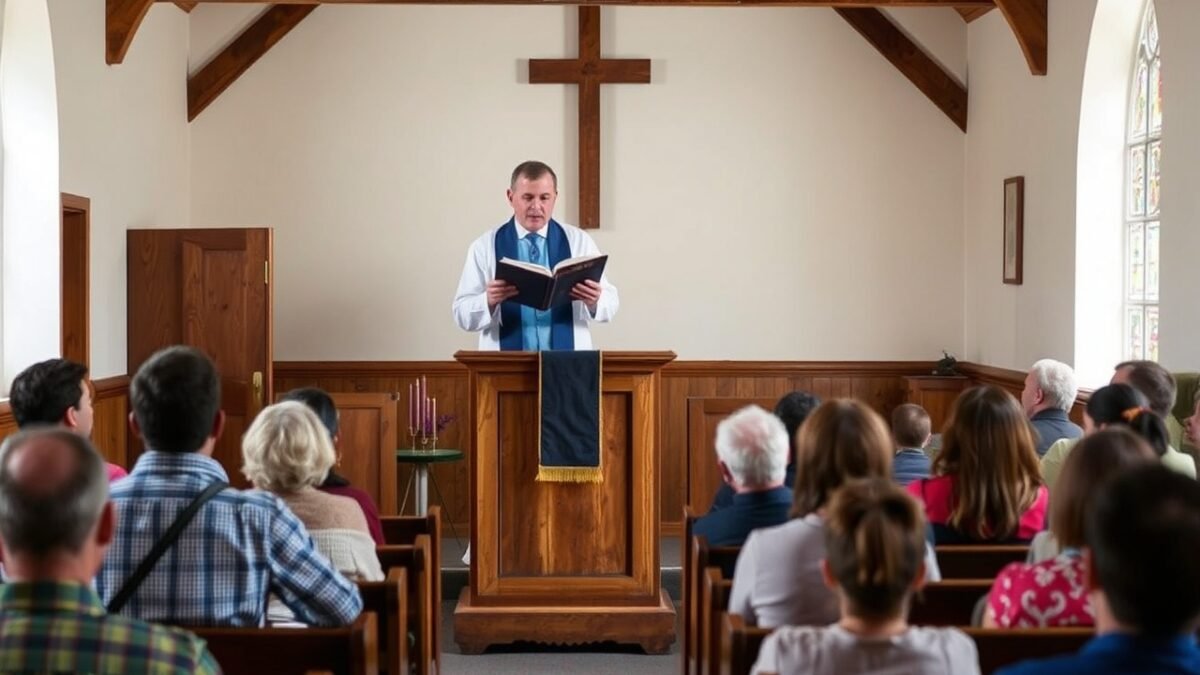
There is a temptation as old as Eden: to take something genuinely good—justice, community, the flourishing of the vulnerable—and quietly replace God with it. We do not usually announce the substitution. We baptize it in biblical language, dress it in the vocabulary of the prophets, and call it faithfulness. But when the text of Scripture is bent to serve a predetermined political conclusion rather than allowed to speak on its own terms, something more than hermeneutics has gone wrong. A throne has been rearranged.
A recent review at The Gospel Coalition examines Robert Wuthnow’s sociological study of progressive religious activism in America. Read the source article. The reviewer, Andrew Spencer, notes that Wuthnow—himself a cheerleader for the Religious Left—inadvertently reveals how cultural narratives drive Christians to reshape doctrine in order to justify political advocacy. The diagnosis is sobering, and it is not a partisan one. The temptation to make politics lord belongs to no single side of the aisle. It belongs to the human heart.
The Biblical Diagnosis: A Heart That Manufactures Its Own Gods
Scripture is unflinching about the human capacity for self-deception in the name of religion. The prophet Jeremiah wrote of a heart that is “deceitful above all things, and desperately sick” (Jeremiah 17:9). This is not a description of flagrant atheists; it is a description of the people of God who had turned the temple into a talisman and the law into a ladder for their own ambitions. They used the language of covenant while pursuing the priorities of the surrounding nations.
“Do not be conformed to this world, but be transformed by the renewal of your mind, that by testing you may discern what is the will of God, what is good and acceptable and perfect.” — Romans 12:2
Paul’s warning in Romans 12:2 is addressed to the church, not to the world. The pressure to conform—to let the dominant cultural narrative set the interpretive agenda for Scripture—is a pressure felt inside the congregation. Wuthnow’s book, Spencer observes, describes a movement whose progressive faith leaders have embraced “a view of human personhood that foregrounds expressivity and fulfillment” and an “optimistic assumption about human nature that focuses less on sin.” That is not a political platform; it is a theology—one that stands in direct contradiction to the biblical account of the human condition. When sin is reframed as merely a “false understanding of oneself,” the cross becomes unnecessary, and the gospel evaporates.
Paul writes in Ephesians 2:1–3 that apart from Christ we are “dead in trespasses and sins,” following “the prince of the power of the air,” and living “in the passions of our flesh.” This is not a flattering portrait, and it cannot be revised by any political movement, however sincere. Any theology that softens this diagnosis will inevitably distort the cure.
The Christ-Centered Answer: A Lord Who Defines Righteousness
The answer to the politicization of faith is not the absence of conviction. Jesus was not apolitical. He proclaimed a Kingdom, called people to repentance, confronted religious hypocrisy, and declared himself Lord over every domain of life. But his Kingdom did not arrive by legislation or cultural dominance. It arrived through a cross.
“For the word of the cross is folly to those who are perishing, but to us who are being saved it is the power of God.” — 1 Corinthians 1:18
The cross is the interpretive center of all Christian ethics. Every appeal to justice, every invocation of the prophets, every argument about the poor and the oppressed must pass through Calvary to be genuinely Christian. Jesus did not come primarily to reform social structures; he came to reconcile sinners to a holy God (2 Corinthians 5:18–19). That reconciliation then produces transformed people who pursue justice, love mercy, and walk humbly—not to build a political kingdom, but as witnesses to the Kingdom that has already broken in through the resurrection.
This is why hermeneutics matter so deeply. When the Jubilee of Leviticus 25 is lifted from its covenantal context and applied wholesale to international debt policy, it is not just a misreading of the text—it is a displacement of Christ from the center. The Year of Jubilee pointed forward to the One who would proclaim “liberty to the captives” (Luke 4:18) in the fullest and most ultimate sense: freedom from sin, death, and the wrath of God. To flatten that typology into a foreign-policy argument is to lose the gospel hiding inside the law.
Living It Out: Discipleship That Resists Conformity
So what does faithfulness look like for ordinary believers navigating a culture that constantly pressures the church to align itself with one political tribe or another? Scripture and the witness of the church across the centuries offer a clear path.
1. Read Scripture on Its Own Terms
Every Christian should develop the habit of asking: What did this text mean to its original hearers, and how does it point to Christ? Before asking what a passage says about a contemporary policy debate, ask what it says about God, humanity, sin, and redemption. Good Bible study is the first line of defense against motivated reasoning.
2. Name the Narratives Around You
Spencer notes that “countercultural catechesis is vital if we’re going to shift the cultural tide.” Churches must teach people to recognize the stories their culture tells about human nature, identity, progress, and justice—and to evaluate those stories against Scripture rather than smuggling them into Scripture. Expressive individualism, the idea that authentic selfhood means releasing oneself from external moral constraints, is a powerful cultural narrative. It is also incompatible with the gospel of a Lord who calls us to deny ourselves (Matthew 16:24).
3. Keep the Gospel Central in Every Conversation
When Christians engage political questions—and we should, as image-bearers with civic responsibilities—the gospel must remain the non-negotiable center. We can hold convictions about policy while refusing to treat any political movement as the vehicle of salvation. The church’s primary calling is not to win elections but to make disciples (Matthew 28:19–20).
4. Guard Against Idolatry on Every Side
The temptation to make politics lord is not unique to the Religious Left. Christians across the political spectrum must regularly examine whether their partisan commitments are shaping their reading of Scripture, or whether Scripture is shaping their political engagement. The question is not which party you support; the question is who sits on the throne of your convictions.
The Gospel: The Only Word That Truly Sets Us Free
Every attempt to build the Kingdom of God through political power—whether from the left or the right—ultimately fails for the same reason: it misunderstands the human problem. Our deepest need is not better policy. It is forgiveness, resurrection, and new creation.
The gospel declares that every human being has sinned and fallen short of the glory of God (Romans 3:23), that the wages of sin is death (Romans 6:23), and that God, in his staggering mercy, sent his Son Jesus Christ to bear that death in our place. Jesus died on the cross as a substitute for sinners, rose bodily from the grave on the third day, and now reigns as Lord over all things. He offers forgiveness, reconciliation with God, and the gift of the Holy Spirit to everyone who turns from sin and trusts in him alone.
“For by grace you have been saved through faith. And this is not your own doing; it is the gift of God, not a result of works, so that no one may boast.” — Ephesians 2:8–9
No political movement can offer this. No revised theology that softens sin and sidelines the cross can deliver what the human soul most desperately needs. But Christ can—and does. The invitation of the gospel is open to every person, regardless of their political identity: come, repent, believe, and find in Jesus the justice, the mercy, and the new life that no earthly kingdom can provide. That is the word the church is called to proclaim, and it must never be traded for anything less.