Introduction: The Battle Between Two Forces
Every single day, you wake up and face a choice. You might not even realize you’re making it, but it’s there. Will you let faith guide your decisions, or will fear take control?
Fear whispers that you’re not good enough. It tells you to play it safe, to avoid risks, and to stay in your comfort zone. Faith, on the other hand, encourages you to take that leap. It reminds you that growth happens when you trust the process, even when the outcome isn’t guaranteed.
The truth is simple: faith matters more than fear because it pushes you forward while fear holds you back. This article will show you exactly why choosing faith over fear can change your life, improve your mental health, and help you achieve things you never thought possible.
What Faith Really Means
Faith isn’t just about religion, though many people connect the two. At its core, faith means believing in something even when you can’t see the full picture. It’s trusting that things will work out, even when the path ahead looks scary.
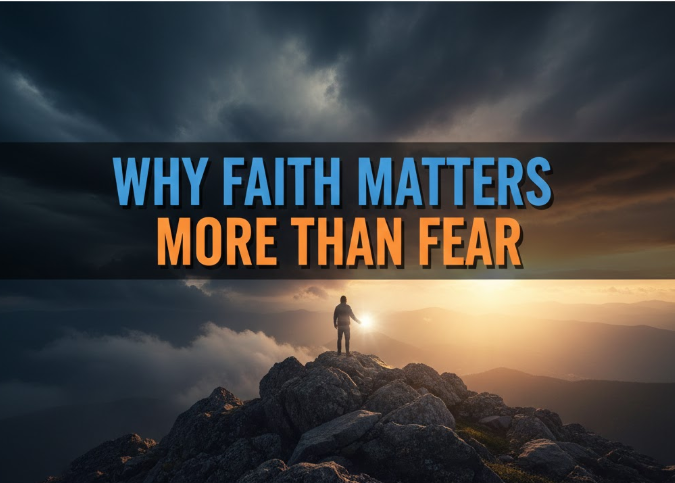
Think of faith as a flashlight in a dark room. You might not see the entire room, but the light shows you the next step. That’s all you need. One step at a time.
Faith shows up in different ways. It’s the student who studies hard believing they’ll pass the exam. It’s the athlete who trains every day trusting they’ll get better. It’s the parent who works two jobs believing their kids will have a better life.
When you have faith, you’re not ignoring reality. You’re choosing to believe that your efforts matter and that good things can happen.
The Problem With Fear
Fear isn’t always bad. It keeps you from touching hot stoves or walking into dangerous situations. But most of the time, fear isn’t protecting you from real danger. It’s protecting you from imaginary worst-case scenarios that probably won’t happen.
Fear makes you think small. It convinces you that failure is the worst thing ever, so you stop trying new things. You avoid asking questions in class because what if people laugh? You don’t apply for that opportunity because what if you’re not qualified?
Here’s what fear does to your life:
Stops you from growing: When you avoid challenges, you never develop new skills.
Damages relationships: Fear of rejection keeps you from forming deep connections.
Limits your potential: You settle for less because reaching for more feels too risky.
Affects your health: Constant worry raises stress levels, messes with sleep, and weakens your immune system.
Fear also spreads. When you’re afraid, you often make others around you fearful too. It creates a cycle where everyone stays stuck in the same place.
How Faith Changes Everything
Faith flips the script. Instead of asking “What if I fail?” you start asking “What if I succeed?” That simple shift in thinking opens up a whole new world.
When you approach life with faith, you see opportunities instead of obstacles. A challenging project becomes a chance to learn something new. A difficult conversation becomes an opportunity to strengthen a relationship.
Faith gives you energy. When you believe in what you’re doing, you wake up motivated. You push through hard days because you trust there’s a purpose behind the struggle.
People with faith take action. They don’t wait for perfect conditions. They start with what they have and figure things out along the way. That’s how businesses get built, books get written, and dreams become reality.
Real-Life Examples of Faith Over Fear
History is full of people who chose faith when fear told them to quit.
Thomas Edison failed thousands of times before inventing the light bulb. He had faith that he’d eventually figure it out.
J.K. Rowling was rejected by twelve publishers before someone said yes to Harry Potter. She had faith in her story when fear could have made her give up.
Malala Yousafzai kept fighting for girls’ education even after being shot. She had faith that her voice mattered more than her fear.
These aren’t superhuman people. They’re regular humans who decided faith was stronger than fear. You have that same choice every single day.
The Science Behind Faith and Fear
Let’s talk about what happens in your brain. When you’re afraid, your amygdala (the fear center) fires up. It releases stress hormones like cortisol and adrenaline. Your body goes into fight-or-flight mode.
This was useful when humans faced actual predators. But today, your brain can’t tell the difference between a lion and a scary presentation. It reacts the same way.
Faith activates different brain regions. When you feel hopeful and confident, your prefrontal cortex (the thinking and planning part) takes charge. You produce feel-good chemicals like dopamine and serotonin.
Studies show that people who practice faith-based thinking have:
- Lower anxiety levels
- Better stress management
- Improved problem-solving abilities
- Stronger immune systems
- Higher life satisfaction
Your brain literally works better when you choose faith over fear.
Building Your Faith Muscle
Faith isn’t something you either have or don’t have. It’s a skill you can develop, just like learning to play guitar or getting better at math.
Start small: You don’t need to make huge leaps. Begin with small acts of faith. Speak up in one meeting. Send that email you’ve been putting off. Each small win builds confidence.
Keep a success journal: Write down times when things worked out, even when you were scared. This creates proof that faith pays off.
Surround yourself with believers: Spend time with people who encourage you and believe in possibilities. Their faith becomes contagious.
Challenge negative thoughts: When fear says “You can’t,” immediately counter with “What if I can?” Question the fearful stories your mind tells.
Take action before you feel ready: Faith means moving forward even when you’re nervous. Action creates momentum.
Faith in Daily Situations
Let’s get practical. How does choosing faith over fear actually look in everyday life?
At school: Faith means raising your hand even when you’re not 100% sure of the answer. It means joining that club or trying out for the team. Fear says stay invisible. Faith says your participation matters.
In relationships: Faith means having honest conversations even when they’re uncomfortable. It means trusting people until they give you a reason not to. Fear builds walls. Faith builds bridges.
With goals: Faith means setting big goals and taking steps toward them daily. It means accepting that failure is part of learning. Fear says play it safe. Faith says aim high.
During tough times: Faith means believing that hard seasons don’t last forever. It means looking for lessons in struggles. Fear says give up. Faith says keep going.
When Faith Feels Impossible
Some days, faith is really hard. When you’ve been disappointed multiple times, when things keep going wrong, when the world feels heavy—faith can seem like a fantasy.
That’s normal. Everyone experiences this.
The key is not to confuse faith with blind optimism. You don’t have to pretend everything is perfect. You can acknowledge that things are hard right now while still believing they can get better.
Faith during dark times looks like taking one tiny step forward. It’s getting out of bed. It’s asking for help. It’s doing one productive thing even when you don’t feel like it.
Remember: faith isn’t about feeling certain. It’s about choosing to move forward despite uncertainty.
Faith Creates Ripple Effects
Here’s something powerful: your faith doesn’t just affect you. It impacts everyone around you.
When a teacher has faith in a struggling student, that student often rises to meet those expectations. When a coach believes in their team, players perform better. When parents have faith in their kids, those kids develop stronger self-belief.
Your faith gives others permission to have faith too. When people see you taking risks, trying new things, and bouncing back from failures, they think “Maybe I can do that too.”
This is how faith multiplies. One person’s courage inspires another’s. Small acts of faith create waves of positive change.
Comparison Table: Faith vs. Fear
| Aspect | Faith | Fear |
|---|---|---|
| Focus | Possibilities and solutions | Problems and worst-case scenarios |
| Action | Encourages forward movement | Creates paralysis and avoidance |
| Energy | Generates motivation and hope | Drains energy and creates stress |
| Relationships | Builds trust and connection | Creates walls and isolation |
| Growth | Welcomes challenges as learning | Avoids challenges to stay safe |
| Health | Reduces stress, improves wellbeing | Increases anxiety, affects physical health |
| Outcomes | Opens doors to opportunities | Limits possibilities and potential |
Practical Steps to Choose Faith Today
Ready to make faith your default setting? Here’s your action plan:
Morning mindset: Start each day by naming three things you’re grateful for and one thing you’re looking forward to. This trains your brain toward faith.
The 5-second rule: When fear tells you not to do something (that’s actually good for you), count backwards from five and take action. Don’t give fear time to build its case.
Reframe failure: Every time something doesn’t work out, ask “What can I learn from this?” Failure becomes feedback, not a reason to quit.
Create a faith playlist: Music that inspires you, quotes that motivate you, videos that lift you up. Consume this content regularly.
Take calculated risks: You don’t have to be reckless. Choose one area of your life to be braver. Maybe it’s your career, your social life, or a personal project.
Celebrate progress: Notice and celebrate every time you choose faith over fear. This reinforces the behavior.
This message about the end times is urgent:
https://ignite.org.es/the-euphrates-river-is-drying-up-and-revelation-16-is-coming-true-you-need-to-see-this/
Why This Matters for Your Future
The choices you make today based on faith or fear will determine where you are five years from now.
If fear wins most days, you’ll likely be in roughly the same place, maybe a little more frustrated because deep down you know you’re capable of more.
If faith wins most days, you’ll be amazed at how much you’ve grown. You’ll have tried things, learned from mistakes, and built a life that reflects your values and dreams.
The best opportunities in life require faith. The job that challenges you. The relationship that makes you vulnerable. The creative project that might fail. The move to a new city. The decision to start over.
Fear will always find reasons to say no. Faith asks “Why not me? Why not now?”
Frequently Asked Questions
What if I have faith and things still don’t work out?
Faith doesn’t guarantee specific outcomes. It guarantees that you’ll grow, learn, and become stronger through the process. Sometimes things not working out is actually redirecting you toward something better.
Isn’t some fear healthy and necessary?
Absolutely. Fear of real danger keeps you safe. The problem is when fear of imaginary scenarios stops you from living fully. The goal isn’t to eliminate all fear but to not let it make your decisions.
How do I know if I’m being faithful or just reckless?
Faith involves thinking things through and making informed decisions while acknowledging uncertainty. Recklessness ignores obvious risks without consideration. Faith is brave, not careless.
Can you have faith without being religious?
Yes. While many people connect faith to religion, you can have faith in yourself, in other people, in the process of growth, or in humanity’s ability to overcome challenges.
What if everyone around me is fearful?
This is tough but common. You might need to limit time with extremely negative people and seek out more positive influences through books, podcasts, online communities, or new friendships.
How long does it take to develop stronger faith?
Like any skill, it varies by person and practice. You might notice small changes in weeks and significant shifts in months. The key is consistency, not perfection.
Conclusion: Your Move
At the end of the day, you get to choose. Fear or faith. Playing small or reaching higher. Staying comfortable or growing stronger.
Faith matters more than fear because life is too short to spend it wondering “What if?” You have unique gifts, ideas, and contributions that the world needs. But fear will convince you to keep them hidden.
Don’t let that happen.
Start today. Choose one area where fear has been winning and make a faith-based decision instead. Send that text. Sign up for that class. Have that conversation. Apply for that position.
You might succeed. You might fail. But either way, you’ll be living instead of just existing. And that’s what faith is really about—fully engaging with life rather than watching from the sidelines.
The world needs more people who choose faith. Be one of them. Your future self will thank you.