Have you ever felt trapped in a pattern of sin you couldn’t escape? You confess it, resolve to stop, and then find yourself back in the same place—ashamed, discouraged, wondering whether real change is even possible. If that resonates, you are not alone. The question Paul addresses in Romans 6 is one of the most urgent questions in the Christian life: How do we actually die to sin?
Read the source article by Jen Oshman at Crossway, which offers a warm and careful walk through Romans 6:1–14. What follows is Ignite’s reflection on the same passage—because this text is not merely theological information. It is the liberating heartbeat of the gospel applied to your everyday struggle.
The Human Problem: Sin Reigns
Before we can appreciate what Christ has done, we must be honest about what we are apart from him. Scripture does not soften the diagnosis. The Apostle Paul writes in Romans 3 that “all have sinned and fall short of the glory of God” (Romans 3:23). This is not a polite exaggeration. It is a description of the human condition from Genesis forward—a race that turned from its Creator and came under the dominion of sin and death.
“For the wages of sin is death, but the free gift of God is eternal life in Christ Jesus our Lord.” — Romans 6:23
Sin is not simply a list of bad behaviors. Paul describes it in Romans 6 as a reign—a tyrant king that enslaves, demands obedience, and pays its servants in death. Jeremiah captured the depth of the problem centuries earlier: “The heart is deceitful above all things, and desperately sick; who can understand it?” (Jeremiah 17:9). We do not merely commit sins; we are, apart from grace, people shaped and ruled by sin. This is why moral effort alone never finally liberates anyone. You cannot overthrow a king simply by trying to ignore him.
The Gospel Answer: United with Christ in Death and Resurrection
Here is where Romans 6 becomes breathtaking. Paul does not respond to the problem of sin’s reign with a self-improvement program. He responds with a declaration about what God has already accomplished in Jesus Christ.
“For if we have been united with him in a death like his, we shall certainly be united with him in a resurrection like his. We know that our old self was crucified with him in order that the body of sin might be brought to nothing, so that we would no longer be enslaved to sin. For one who has died has been set free from sin.” — Romans 6:5–7
The cross was not merely a historical event that happened for us at a distance. Through faith, the believer is united with Christ in his death. Our old self—the self that was under sin’s dominion—was crucified with him. This is not metaphor for moral improvement. It is a declaration of a new identity, a new legal and spiritual reality. Paul echoes this in Galatians: “I have been crucified with Christ. It is no longer I who live, but Christ who lives in me. And the life I now live in the flesh I live by faith in the Son of God, who loved me and gave himself for me” (Galatians 2:20).
And the resurrection matters just as much as the cross. Because Christ was raised from the dead—bodily, historically, triumphantly—those who are in him are raised to walk in “newness of life” (Romans 6:4). The resurrection is not a postscript to the gospel. It is the proof that sin and death have been defeated, and it is the power source for the Christian’s new life. As Paul writes elsewhere, “If the Spirit of him who raised Jesus from the dead dwells in you, he who raised Christ Jesus from the dead will also give life to your mortal bodies through his Spirit who dwells in you” (Romans 8:11). The same resurrection power that emptied the tomb is at work in the believer today.
The Command: Consider Yourself Dead to Sin
Romans 6:11 contains one of the most practically important commands in all of Scripture: “So you also must consider yourselves dead to sin and alive to God in Christ Jesus.” The word consider (Greek: logizomai) is an accounting term. It means to reckon, to count something as true, to act on a settled reality. Paul is not telling us to make ourselves dead to sin by sheer willpower. He is telling us to reckon what is already true because of Christ.
This is the difference between striving and resting in the right way. The Christian does not fight sin in order to become free. The Christian fights sin because they are already free. The battle is real, but the outcome has been decided at Calvary and confirmed at the empty tomb.
Living It Out: Practical Discipleship in Romans 6
1. Preach the Gospel to Yourself Daily
When temptation rises, the first response is not white-knuckled resistance—it is remembrance. Remind yourself of who you are in Christ. You are not a slave to sin. You are a child of God, united with the risen Lord. “For sin will have no dominion over you, since you are not under law but under grace” (Romans 6:14). Let that truth land before you act.
2. Present Your Body to God
Paul’s language in Romans 6:13 is deliberate and physical: present your members to God as instruments for righteousness. Sanctification is not abstract. It involves your eyes, your hands, your tongue, your time, your money. Each morning, offer these concretely to the Lord. Ask: How can this body, this day, be an instrument of God’s righteousness rather than a foothold for sin?
3. Remember Your Baptism
Baptism is not a mere ritual. It is a public, embodied declaration that you have died with Christ and been raised with him. Whether you were immersed or sprinkled, that act proclaimed to the watching world—and to your own soul—that the old self is buried and the new self lives. On hard days, return to that moment. You went under the water. You came up. That is your story.
4. Walk in Community
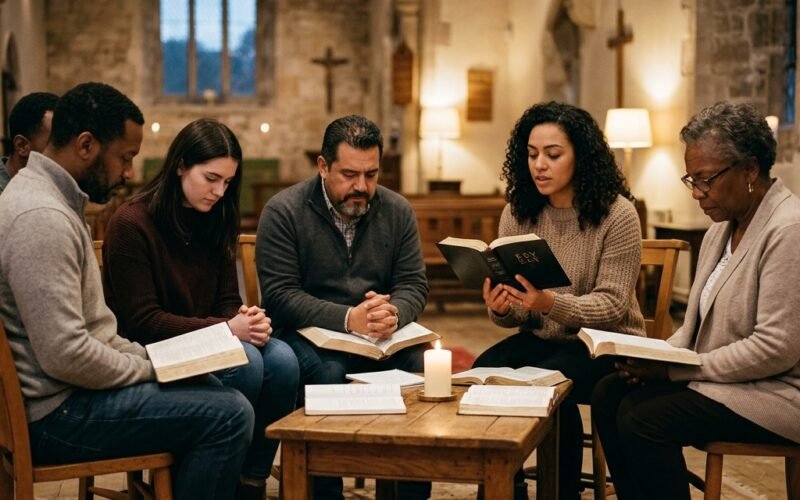
The letter to the Romans was written to a community, not an isolated individual. Dying to sin is not a solo project. Hebrews 3:13 calls us to “exhort one another every day, as long as it is called ‘today,’ that none of you may be hardened by the deceitfulness of sin.” Find brothers and sisters who will speak truth to you, pray with you, and hold you accountable to the identity you have in Christ.
The Gospel: The Only Foundation That Holds
Every human being carries the weight of sin—not just the guilt of individual failures, but the deeper bondage of a nature curved away from God. No philosophy, no discipline, no religion of self-improvement can break that bondage. Only one thing can: the death and resurrection of Jesus Christ.
Jesus, the eternal Son of God, took on flesh and lived the perfectly obedient life we could not live. He went to the cross bearing the full weight of human sin—your sin, my sin—and absorbed the wrath of God in our place. He was buried. And on the third day, God raised him from the dead, declaring that sin and death are defeated, that the debt is paid, that the tyrant has been overthrown.
The invitation of the gospel is this: repent—turn from trusting in yourself—and place your faith in Jesus Christ alone. When you do, you are united with him. His death becomes your death to sin. His resurrection becomes your new life. You are no longer under the reign of sin. You are under the reign of grace.
If you have never made that surrender, today is the day. And if you have—if you belong to Christ—then hear Paul’s word afresh: consider yourself dead to sin and alive to God in Christ Jesus. Walk in what is already true. You are free. Live like it.