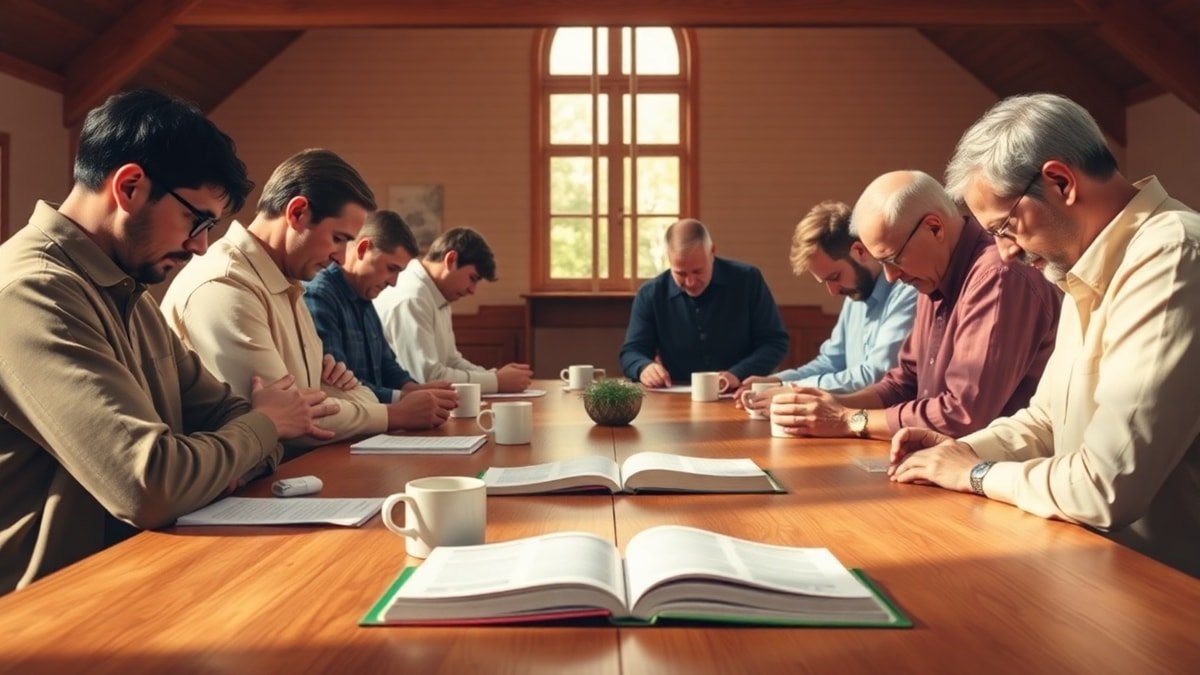
There is a loneliness that does not announce itself. It settles quietly into the life of a man who preaches hope to hundreds on Sunday morning and then drives home in silence, unsure whether anyone truly knows the weight he carries. Across the United States—and across the world—pastors are experiencing exactly this kind of hidden isolation. The pressures of cultural upheaval, congregational conflict, and the relentless demands of ministry have left many shepherds feeling, in the words of one church planter, like they are on an island. That image is striking precisely because it is so contrary to the vision Scripture paints for those who labor in God’s kingdom.
Read the source article — Arthur Gonçalves of Sanford, Florida, writes compellingly about how a season of pastoral isolation drove him to form a local coalition of pastors, and how the gospel of Jesus Christ became the only sufficient foundation for their unity.
The Biblical Diagnosis: We Were Not Made for Solitude
The problem of pastoral isolation is not merely organizational or psychological. It is, at its root, a theological problem—a symptom of a world fractured by sin. When Adam and Eve turned from God in the garden, the immediate consequence was not only alienation from their Creator but alienation from one another. Shame drove them into hiding; blame drove them apart (Genesis 3:7–12). That fracturing of human community has echoed through every generation since, including into the fellowship halls and study rooms of the church.
“Two are better than one, because they have a good reward for their toil. For if they fall, one will lift up his fellow. But woe to him who is alone when he falls and has not another to lift him up!” (Ecclesiastes 4:9–10, ESV)
The Preacher of Ecclesiastes understood that isolation is not strength—it is vulnerability. A man alone who falls has no one to help him rise. This is not a commentary on weakness of character; it is a description of the human condition in a broken world. The apostle Paul confirms this when he writes to the Galatians: “Bear one another’s burdens, and so fulfill the law of Christ” (Galatians 6:2). The law of Christ—the royal law of love—is fulfilled not in heroic self-sufficiency but in the humble, costly act of carrying what another cannot carry alone.
Pastors are not exempt from this need. They are, in fact, uniquely susceptible to the lie that they must be. The expectation—sometimes self-imposed, sometimes projected by congregations—that a shepherd must always be the strong one, the one with answers, the one who does not need to be pastored, is a distortion the enemy is glad to encourage. Burnout and early exits from ministry are among its bitter fruits.
The Christ-Centered Answer: A Unity Purchased at the Cross
The good news is that Jesus Christ did not simply teach unity as a virtue. He secured it as a reality through his death and resurrection. On the night before the cross, he prayed with an urgency that should still move us: “I do not ask for these only, but also for those who will believe in me through their word, that they may all be one, just as you, Father, are in me, and I in you” (John 17:20–21). The unity of the church is not a human achievement to be organized into existence. It is a gift rooted in the very life of the triune God, made available to sinners through the reconciling work of Christ.
“For he himself is our peace, who has made us both one and has broken down in his flesh the dividing wall of hostility… that he might create in himself one new man in place of the two, so making peace, and might reconcile us both to God in one body through the cross.” (Ephesians 2:14–16, ESV)
Paul’s language here is staggering. The cross does not merely encourage unity—it creates it. The dividing wall is demolished not by dialogue or goodwill, but by the body of Jesus Christ broken for sinners. This means that when pastors gather around the gospel, they are not simply networking. They are standing on ground that was purchased with blood. They are inhabiting a peace that was won, not manufactured. The renewal that Gonçalves describes—weary pastors singing together, praying Scripture over one another, weeping and laughing at the same table—is not a program outcome. It is the gospel becoming visible in human community.
The risen Christ also modeled what it looks like to shepherd shepherds. After the resurrection, he sought out Peter—a man who had denied him three times and was surely drowning in shame—and restored him tenderly, asking not once but three times: “Do you love me?… Feed my sheep” (John 21:15–17). Jesus did not leave his broken shepherd to figure it out alone. He came to him, recommissioned him, and sent him back into the work. This is the pattern: the Good Shepherd tends his under-shepherds so that they, in turn, can tend his flock.
Living It Out: Building a Culture of Pastoral Community
What does it look like, practically, for pastors and churches to resist isolation and embrace the gospel-shaped community Scripture commends? Several principles emerge from both Scripture and the experience of those who have walked this road.
1. Begin with Honest Friendship, Not Agendas
The first step Gonçalves took was simply to reach out—not to recruit, not to build a platform, but to be a friend. Proverbs reminds us that “a friend loves at all times, and a brother is born for a time of adversity” (Proverbs 17:17). Pastoral relationships built on competition or suspicion cannot bear the weight of real ministry burdens. Relationships built on honest friendship, over time, can bear almost anything.
2. Let Prayer Be the Foundation, Not the Formality
At the first gathering Gonçalves describes, a pastor invited the group to pair with someone unknown and pray Scripture over one another. This is not a technique—it is obedience. “Pray for one another, that you may be healed” (James 5:16). When pastors pray together, they are reminded that the ministry does not ultimately rest on their shoulders. It belongs to Jesus, and he is interceding for his church even now (Hebrews 7:25).
3. Anchor Every Gathering in the Word and the Gospel
Programs and initiatives cannot sustain a coalition of pastors. Only the gospel can. Every gathering should return to the person and work of Jesus Christ—his sufficient atonement, his bodily resurrection, his present lordship, his coming return. When the gospel is central, secondary differences recede and genuine unity becomes possible.
4. Connect Generations Intentionally
One of the most beautiful elements of Gonçalves’s story is the pairing of young church planters with seasoned shepherds. This is the pattern of Titus 2 applied to pastoral life: “Older men are to be sober-minded, dignified, self-controlled, sound in faith, in love, and in steadfastness” (Titus 2:2)—and they are to pass that soundness on. Wisdom is not downloaded; it is transmitted through relationship across generations.
The Gospel Proclaimed: Why Any of This Is Possible
We close where every true gathering of pastors must close—with the gospel itself. Every human being, including every pastor, has sinned and fallen short of the glory of God (Romans 3:23). We are, by nature, people who hide, who compete, who protect ourselves at the expense of others. No amount of organizational structure or goodwill can fix that. What we need is not a better system. We need a Savior.
Jesus Christ, the eternal Son of God, entered our fractured world, lived the life we could not live, and died the death we deserved. He bore the full weight of human sin—including our pride, our isolation, our self-sufficiency—on the cross. Three days later, he rose from the dead, defeating sin and death and opening the way for every broken, weary, isolated person to be reconciled to God and to one another. “If you confess with your mouth that Jesus is Lord and believe in your heart that God raised him from the dead, you will be saved” (Romans 10:9).
This is the only foundation on which genuine community—pastoral or otherwise—can be built. When fifty pastors gather in Orlando and find themselves weeping and singing the doxology together, something more than human warmth is at work. The Spirit of the risen Christ is knitting his people together, fulfilling the prayer of John 17, making visible the invisible kingdom. No shepherd has to be an island. The cross has already broken down the wall.