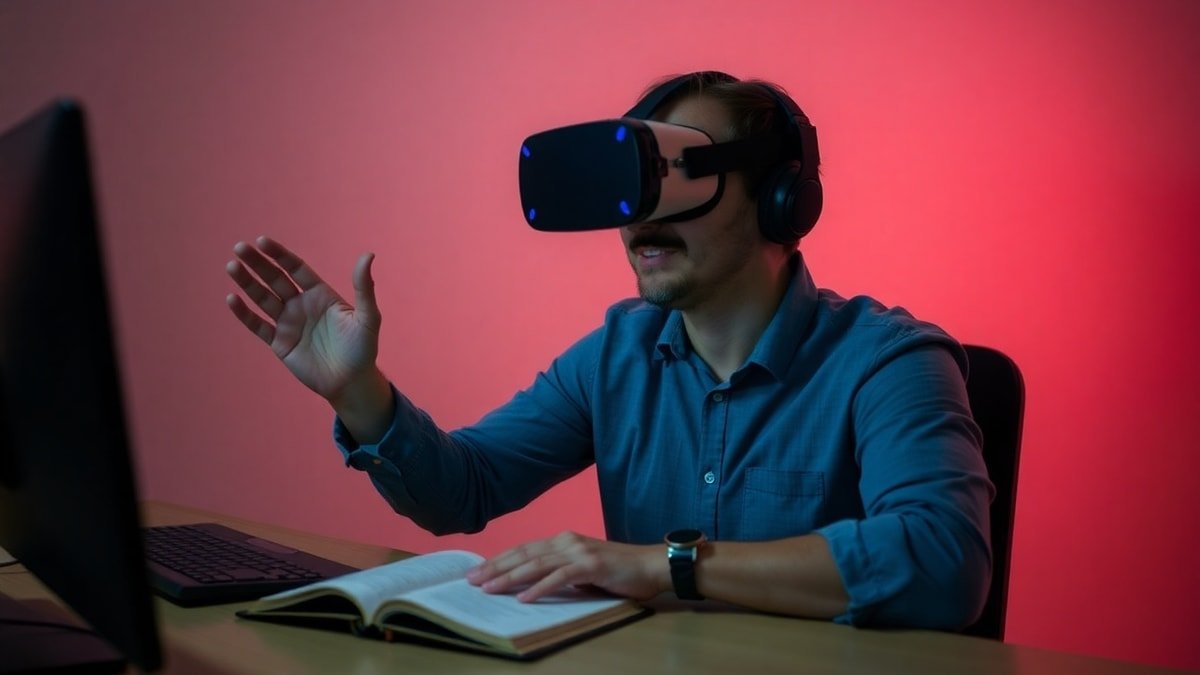
There is a Japanese-style penthouse in a virtual world where a stormtrooper and an orange cat bow their heads in prayer. The room is rendered in pixels. The loneliness that drove millions of people into that room is not. Read the source article from Religion News Service, which profiles Cru missionaries who have spent three years entering VRChat—a social virtual reality platform with millions of users—to listen, befriend, and proclaim Jesus Christ to people searching for something real in a digital world.
The story is remarkable not primarily because of the technology. It is remarkable because of what it reveals about the human heart: that even in a world built entirely of imagination, people are still lonely, still hurting, still reaching for hope. The platform changes. The hunger does not.
A Diagnosis the Bible Already Knew
Before we can understand why people spend ten thousand hours inside a virtual world, we need to understand what Scripture says about the condition of the human soul apart from God. The Bible does not treat loneliness, addiction, and restless searching as modern problems. It treats them as ancient ones, rooted in something deeper than circumstance.
“The heart is deceitful above all things, and desperately sick; who can understand it?” — Jeremiah 17:9 (ESV)
Geoffery Powell, a 28-year-old computer scientist who spent seven years in VRChat before joining Cru’s missionary team, described what he witnessed in those virtual spaces: loneliness, alcoholism, suicidal ideation, and sexual exploitation. “As I got to know the community more,” he said, “I really started to feel the hurt.” This is not a portrait of a broken platform. It is a portrait of broken people—people the Apostle Paul described in Ephesians 2:1 as “dead in the trespasses and sins” in which they once walked, following the course of a world that promises life and delivers emptiness.
Stewart Freeman’s story is a case study in that emptiness. After a six-year relationship ended, he poured himself into VRChat—logging over ten thousand hours, often staying online until 5 a.m. “I was juggling relationships with different women in that space,” he said, “and chasing every way that the space would try and claim that it would have a reason for hope.” Romans 1:21 describes this exact trajectory: people who “knew God” but did not honor him, whose “foolish hearts were darkened,” who exchanged the glory of God for substitutes that could never satisfy. The virtual world did not create Freeman’s hunger. It simply became the latest vessel into which he poured it.
Jesus Goes Where People Are
The instinct of Cru’s missionaries—to enter an unfamiliar space, learn its culture, and build genuine relationships before speaking of Christ—is not a modern marketing strategy. It is a deeply biblical pattern modeled by Jesus himself.
“And the Word became flesh and dwelt among us, and we have seen his glory, glory as of the only Son from the Father, full of grace and truth.” — John 1:14 (ESV)
The Incarnation is the original act of missional presence. God did not shout instructions from a distance. He entered the world—its dust, its grief, its social margins—and made his dwelling among the people he came to save. When Jesus sat at the table of Zacchaeus, a man whose life was built on exploitation and self-protection, he did not begin with a theological lecture. He said, “I must stay at your house today” (Luke 19:5, ESV). Presence preceded proclamation, and proclamation was made possible by presence.
Frank Kuligowski, Cru’s digital strategist, described the missionaries’ approach in almost identical terms. They enter a virtual world, find a small group in a quiet corner, and begin: “Cool avatar. Did you make it?” They listen. They ask about faith only when the door opens naturally. “How can we bless them and love them and listen to them?” Kuligowski said. This is not a technique. It is a theology—the theology of a Savior who went to where the lost were and met them in their actual condition.
The Apostle Paul made this same commitment explicit: “I have become all things to all people, that by all means I might save some. I do it all for the sake of the gospel” (1 Corinthians 9:22–23, ESV). Paul reasoned in synagogues, debated in the Areopagus, and wrote letters to house churches across the Roman world. The medium was always secondary to the message. If Paul had a VR headset, he would have used it.
The Gospel That Travels
Stewart Freeman’s transformation is the theological center of this story. A pastor named Jason Poling began visiting Freeman’s private virtual world—his “home world”—every week to read Scripture and walk through the gospel with him. Freeman had grown up calling himself a Christian because his parents did. But something was different this time. “It was the first time where I believed the gospel,” he said.
That sentence deserves to be read slowly. The gospel is not a cultural inheritance. It is not a family tradition. It is a specific announcement about specific events: that Jesus Christ, the eternal Son of God, took on human flesh, lived the life we could not live, died the death we deserved, and rose bodily from the grave on the third day—and that everyone who turns from sin and trusts in him receives forgiveness, adoption into God’s family, and life that death cannot end. Freeman had heard the words before. In a virtual world, through a pastor willing to show up week after week, he finally heard what the words meant.
After his conversion, Freeman sold his business, moved to Orlando, and joined Cru’s Jesus Film Project to bring the gospel to others in VR. “One of the main things nearest and dearest to my heart,” he said, “is stepping into the darkest of those places, growing in relationship with the individuals in that space, and pointing them to the answer they’re searching for.” This is discipleship: a person who has been found going back to find others.
Living It Out: What This Means for Every Believer
1. Recognize the mission field in front of you
You do not need a VR headset to apply this lesson. The principle is that the gospel goes where people are. Jesus commanded his disciples to go into “all the world” (Mark 16:15, ESV)—and in 2026, part of that world is digital. Whether your mission field is a virtual platform, a workplace break room, a neighborhood sidewalk, or a family dinner table, the call is the same: be present, listen well, and be ready to speak of the hope within you (1 Peter 3:15, ESV).
2. Let love precede the message
Nic, a social worker from Denmark who met the Cru missionaries in a virtual Japanese garden, said simply: “You guys are really calm. Just listening.” That quality of unhurried, attentive presence is itself a form of witness. People who have been used, ignored, or preached at from a distance can recognize genuine care. “By this all people will know that you are my disciples,” Jesus said, “if you have love for one another” (John 13:35, ESV). Love is not a strategy that precedes the gospel. Love is part of the gospel made visible.
3. Trust the power of Scripture in any medium
When Nic mentioned using oracle cards for guidance, a missionary sent him a Scripture passage on Discord. Simple. Unforced. Rooted in the Word. Isaiah 55:11 promises that God’s word “shall not return to me empty, but it shall accomplish that which I purpose” (ESV). The channel of delivery does not limit the power of the message. Plant the seed. Trust the One who makes things grow.
The Gospel, Plainly Stated
Every person in VRChat—behind every anime avatar, every floating cat, every stormtrooper—is an image-bearer of God who has wandered from him. So has every person reading this article. Scripture is clear: “All have sinned and fall short of the glory of God” (Romans 3:23, ESV), and “the wages of sin is death” (Romans 6:23, ESV). No virtual world, no relationship, no achievement can close that gap.
“But God shows his love for us in that while we were still sinners, Christ died for us.” — Romans 5:8 (ESV)
Jesus Christ bore the full weight of human sin on the cross. He was buried, and on the third day he rose—defeating death, vindicating his claims, and opening the way back to God. This is not mythology. It is the best-attested event in the ancient world, and it changes everything. “If you confess with your mouth that Jesus is Lord and believe in your heart that God raised him from the dead, you will be saved” (Romans 10:9, ESV).
That salvation is available to the missionary in the VR headset and to the lonely user on the other side of the screen. It is available to you. The world has moved online. The gospel has always been on the move. And the risen Christ—who crossed every boundary to reach us—is still sending his people into every frontier, virtual or otherwise, with the same unchanging news: he is alive, and he saves.