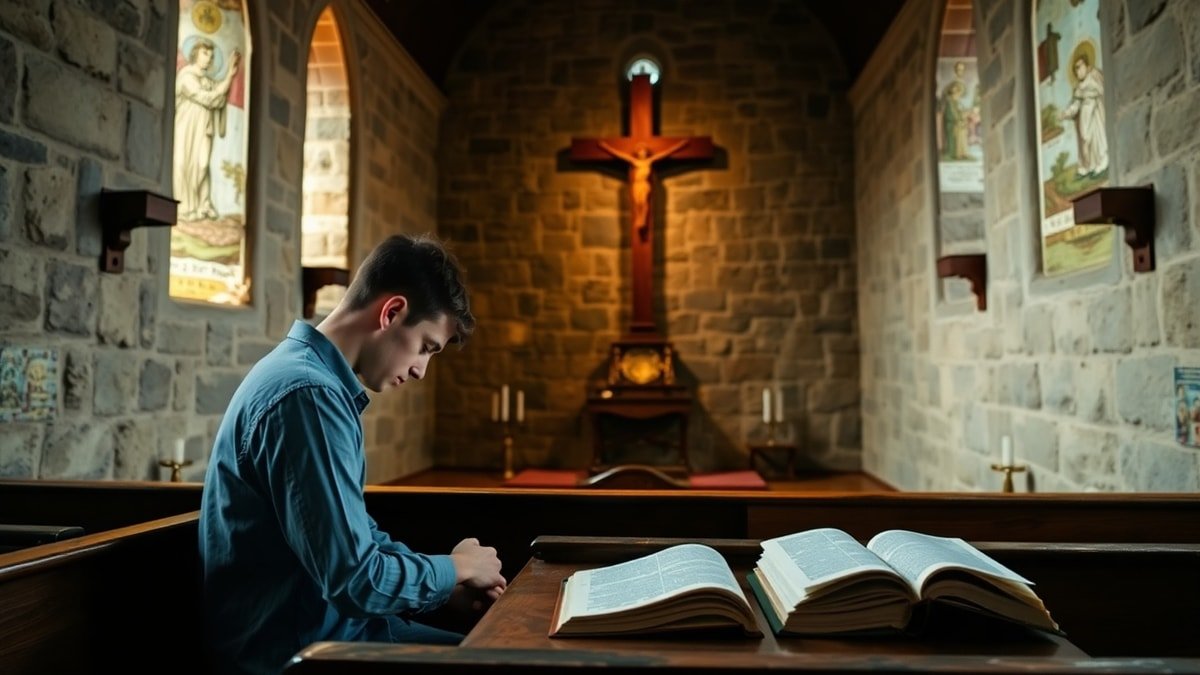
There is a longing buried deep in the human heart—a sense that something has gone terribly wrong, that we are cut off from something we were made for. Philosophers call it alienation. Poets call it longing. The Bible calls it what it is: the consequence of sin. And the good news of the Christian faith is that God did not leave us stranded on our side of the divide. He sent a Mediator.
Read the source article by theologian Vern S. Poythress, whose careful biblical scholarship forms the foundation for the teaching below.
The Barrier Is Real: What Scripture Says About the Human Condition
Before we can appreciate the Mediator, we must be honest about the barrier. The Bible does not soften the diagnosis. Every human being born since the fall of Adam enters the world in a condition of spiritual hostility toward God—not merely ignorance, but active rebellion. The apostle Paul states it plainly:
“For all have sinned and fall short of the glory of God.” (Romans 3:23)
This is not a cultural observation. It is a theological verdict. The prophet Isaiah echoes it centuries earlier: “We have all become like one who is unclean, and all our righteous deeds are like a polluted garment. We all fade like a leaf, and our iniquities, like the wind, take us away” (Isaiah 64:6). The problem is not merely behavioral—it is relational. God is holy, and sin has fractured the relationship between the Creator and his creatures at its deepest root.
The Apostle Paul elaborates in Ephesians: “And you were dead in the trespasses and sins in which you once walked… and were by nature children of wrath, like the rest of mankind” (Ephesians 2:1–3). Dead. Not wounded, not confused, not slightly off-course—dead. This is the biblical diagnosis, and it demands a solution beyond human reach. A dead man cannot negotiate his own resurrection. A guilty defendant cannot serve as his own judge. Humanity needed someone to step into the gap from the outside.
A History of Shadows: Mediation Before Christ
God, in his mercy, did not leave his people without signposts pointing toward the solution. Throughout the Old Testament, he established patterns of mediation—priests, prophets, and kings—each one a partial, anticipatory answer to the problem of sin-caused alienation.
Aaron and his sons were appointed as priests to stand between God and Israel, offering sacrifices and interceding on behalf of the people. Melchizedek, the mysterious priest-king of Salem, served Abraham and was later invoked in the Psalms as a type of an eternal priesthood: “The Lord has sworn and will not change his mind, ‘You are a priest forever after the order of Melchizedek'” (Psalm 110:4). The tabernacle itself was a mediatorial institution—its architecture narrating, in stone and curtain and blood, the story of how a sinful people might draw near to a holy God.
Even the false priesthoods of the surrounding nations—the priests of Baal, the idolatrous clergy of Egypt—bear a twisted witness to this universal human intuition: we cannot reach the divine on our own. We need a go-between. The counterfeits confirm the need for the genuine. As Poythress observes, even false priests, in their distorted way, testify that people cannot get to God by themselves. The tragedy is that they point to a real need while offering a deadly lie in response.
But all the true shadows—the Levitical priesthood, the sacrificial system, the prophetic word, the Davidic kingship—were never the final answer. They were fingers pointing toward the One who would fulfill them all.
The One True Mediator: Jesus Christ, Prophet, Priest, and King
The New Testament announces with breathtaking clarity what the Old Testament could only foreshadow. The writer of Hebrews opens his letter with a declaration that collapses all three offices—prophet, priest, and king—into a single, glorious person:
“Long ago, at many times and in many ways, God spoke to our fathers by the prophets, but in these last days he has spoken to us by his Son, whom he appointed the heir of all things, through whom also he created the world. He is the radiance of the glory of God and the exact imprint of his nature, and he upholds the universe by the word of his power. After making purification for sins, he sat down at the right hand of the Majesty on high.” (Hebrews 1:1–3)
In three verses, the entire architecture of mediation is fulfilled. Jesus speaks as the Prophet—God’s final and definitive Word. He rules as the King—upholding the universe by his power. And he serves as the Priest—making purification for sins. No Levitical priest could do what Jesus did, because every human priest was himself a sinner requiring atonement. But Jesus, the sinless Son of God, could offer himself as the perfect sacrifice. Paul captures this in one of Scripture’s most concentrated statements of the gospel: “For there is one God, and there is one mediator between God and men, the man Christ Jesus, who gave himself as a ransom for all” (1 Timothy 2:5–6).
The goal of Christ’s mediation is not a reluctant truce—it is full reconciliation. God’s justice is not set aside; it is satisfied. The wrath that our sin deserved fell upon Jesus at the cross. And through his resurrection, he opened a new and living way into the very presence of God. The curtain of the temple was torn in two (Matthew 27:51)—the barrier demolished, not by human effort, but by divine love.
Living It Out: What the Mediator Changes for Us Today
The doctrine of Christ as Mediator is not merely theological furniture. It reshapes how we live, pray, and relate to God every day.
1. Come Boldly to God in Prayer
Because Jesus is our great High Priest, we are invited to approach God not with dread, but with confidence. “Let us then with confidence draw near to the throne of grace, that we may receive mercy and find grace to help in time of need” (Hebrews 4:16). Prayer is not a ritual performance—it is a child speaking to a Father, through a Mediator who has already opened the door.
2. Rest in His Finished Work
The temptation to earn God’s favor through religious effort is ancient and persistent. But the Mediator’s work is finished. He sat down at the right hand of the Father (Hebrews 1:3)—a posture that signals completion. Our standing before God rests entirely on what Christ has done, not on what we can accumulate.
3. Intercede for Others
Because we have been brought near to God through Christ, we are now called to be agents of his reconciling love in the world. We carry the message of the Mediator to those still on the other side of the barrier. “We are ambassadors for Christ, God making his appeal through us. We implore you on behalf of Christ, be reconciled to God” (2 Corinthians 5:20).
4. Read the Old Testament with New Eyes
Every priest, every sacrifice, every tabernacle curtain in the Old Testament is a signpost pointing to Jesus. Reading Scripture through this lens transforms Bible study into an act of worship—we see the whole story bending toward the cross and the empty tomb.
The Gospel: The Barrier Has Been Broken
Here is the heart of what the Christian faith proclaims: you are a sinner, and so am I. The barrier between us and a holy God is real, and we could never cross it on our own. But God, in his inexhaustible love, sent his Son—fully God and fully man—to be the Mediator we could never be for ourselves. Jesus lived the life we could not live, died the death we deserved to die, and rose from the grave on the third day, conquering sin and death forever.
The invitation of the gospel is not to try harder or be better. It is to come—to turn from sin and trust in Jesus Christ, the one Mediator, who has already done everything necessary to bring you into the presence of a holy and loving God. “For God so loved the world, that he gave his only Son, that whoever believes in him should not perish but have eternal life” (John 3:16).
The barrier is broken. The way is open. Come to the Mediator.