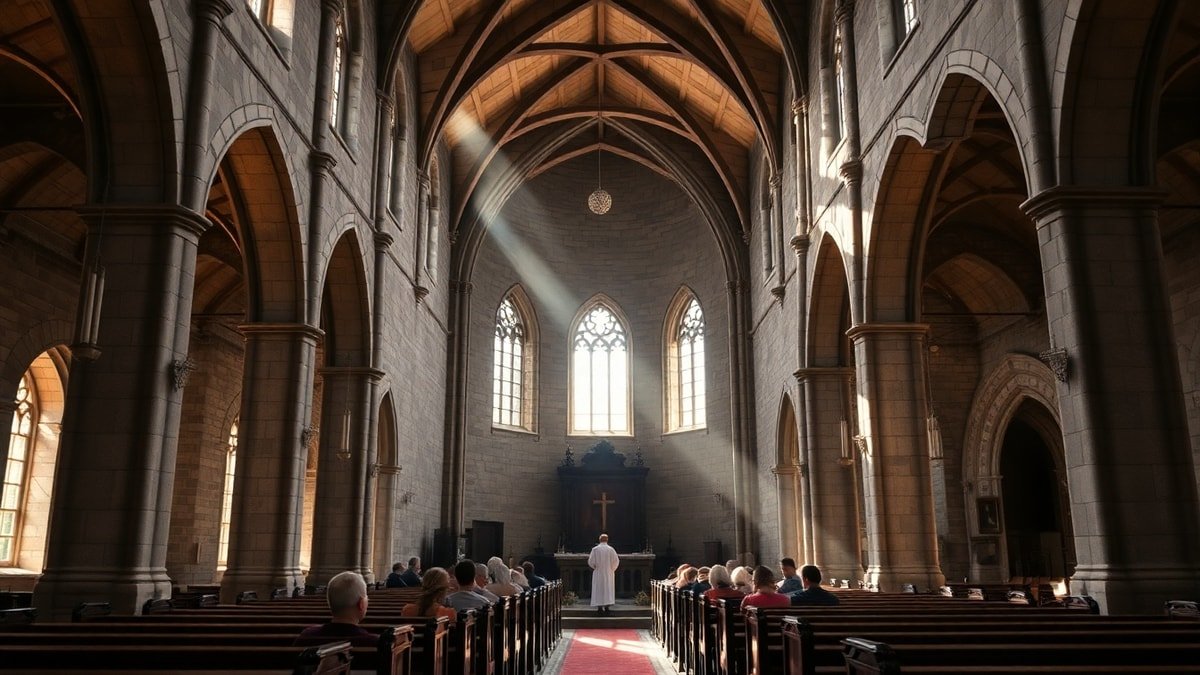
There is a particular kind of grief that comes from walking past a church that is no longer a church. The stained glass has been replaced with a cocktail menu. The nave where generations knelt in prayer now hosts a DJ booth. The baptismal font, if it survived at all, holds ice for craft beer. Aberdeen, Scotland — now the most secular city in the most secular country in the United Kingdom — is full of such buildings. A photographer once documented the phenomenon with a title that stings: Jesus Has Left the Building.
But Jesus has not left. He never promised to be bound to bricks. He promised something far more durable: “I will build my church, and the gates of hell shall not prevail against it” (Matthew 16:18, ESV). The story of Trinity Church Aberdeen — which recently reclaimed and restored a 120-year-old granite Presbyterian sanctuary in the heart of that secular city — is a living parable of that promise. Read the source article for the full account of their remarkable journey.
When Stones Are Left to Testify Alone
The building that Trinity Church purchased in 2018 was barely functional. The roof leaked, the windows were shattered, the wiring was obsolete, and the load-bearing pillars were failing. The congregation that had once filled its 1,000-seat sanctuary had dwindled to thirty people rattling around in a monument to their own decline. A real estate agent advised Trinity’s 250 members not to bother with the whole structure — it was too much, too costly, too far gone.
This is the condition Scripture describes not just for buildings, but for the human heart apart from God. The prophet Isaiah saw it clearly: “Your country lies desolate; your cities are burned with fire; in your very presence foreigners devour your land; it is desolate, as overthrown by foreigners” (Isaiah 1:7, ESV). Paul echoes the diagnosis in Ephesians: “You were dead in the trespasses and sins in which you once walked” (Ephesians 2:1–2, ESV). Dereliction is not merely an architectural problem. It is the human condition — grand structures built for glory, now hollowed out, the original purpose abandoned, the witness silenced.
“The point of an Ebenezer is it marks the moment you consecrate a space,” said Trinity’s senior pastor David Gibson. “The stone represents it forever — even after you’re gone, that memorial stone is still there. And you can either testify with the stone for the rest of your life and ministry that this is what the building is for, or you can leave the gospel and turn the building into something else. But the stone doesn’t stop testifying. The stone still preaches. And it can either testify with you or against you.”
Gibson was drawing on 1 Samuel 7:12, where the prophet Samuel raised a stone after God delivered Israel and named it Ebenezer — “stone of help” — declaring, “Till now the LORD has helped us.” Every consecrated space, every life surrendered to Christ, every community gathered in His name becomes such a stone. The question is never whether it will testify. The question is what it will say.
The Gospel That Cannot Be Contained
Trinity Church’s story did not begin with a building. It began with faithfulness under pressure. In 2011, the congregation — then called High Church, Hilton — became the first church to leave the Church of Scotland over the ordination of a same-sex pastor. They left behind their name, their denominational home, and their building. For years they worshipped in a hotel ballroom that sometimes smelled of the previous night’s liquor and bore the debris of parties that had nothing to do with the living God.
It is precisely this kind of faithfulness — unglamorous, costly, sustained over years — that Scripture holds up as the mark of genuine discipleship. The apostle Paul, writing from prison, declared: “I have learned, in whatever situation I am, to be content. I know how to be brought low, and I know how to abound. In any and every circumstance, I have learned the secret of facing plenty and hunger, abundance and need. I can do all things through him who strengthens me” (Philippians 4:11–13, ESV).
“The whole experience was God’s kindness,” Gibson said. “He was giving me and Trinity not what we wanted, but what we really needed.”
What they needed, it turned out, was not simply a building. They needed the formation that comes from waiting, from trusting, from watching God provide in ways that confound human calculation. The renovation was beset by COVID-19 delays, the Russian invasion of Ukraine driving up material costs, and bids that came back $1.8 million over budget. Each obstacle became, in retrospect, a classroom. Hudson Taylor’s famous words — “First impossible, then difficult, then done” — became the congregation’s lodestar. And so it proved.
Living It Out: What Reclaimed Stones Teach the Church
The story of Trinity Aberdeen is not merely inspiring. It is instructive. Here are three discipleship lessons the church’s journey presses upon every believer and every congregation:
1. Faithful presence is a form of proclamation.
When Trinity’s doors were thrown open on Sunday mornings, passersby stopped. Some walked in. The building — lit up at night, name in lights on the facade — became a witness before a single sermon was preached to a newcomer. “You are the light of the world. A city set on a hill cannot be hidden” (Matthew 5:14, ESV). Showing up, staying, and refusing to abandon a post is itself a form of gospel proclamation in a world that expects the church to retreat.
2. The mission always turns left.
Gibson described the building’s location as sitting on a fault line: turn right and you face the wealth and power of Aberdeen’s judicial and economic center; turn left and you face social deprivation and need. “Our first priority,” he said, “is to go left.” This is the trajectory of the incarnation itself. The Son of God did not come to the comfortable. He came to the lost, the broken, the addicted, the outcast. Trinity’s new addiction recovery ministry and vacation Bible school are not programs — they are acts of theological obedience.
3. Impossible is where God begins.
When the renovation budget collapsed, a donor Gibson expected to refuse him instead offered professional project management. When Gibson despaired to his wife that he couldn’t see the way forward, she replied: “Isn’t that the point — that you don’t see the way? You’ve got to keep trusting.” “Trust in the LORD with all your heart, and do not lean on your own understanding. In all your ways acknowledge him, and he will make straight your paths” (Proverbs 3:5–6, ESV). The church that learns to operate in dependence on God rather than the sufficiency of its own resources is the church that will endure.
The Gospel the Stones Have Always Been Preaching
Every church building that has ever stood — every granite wall, every carved wooden pew, every steeple pointing skyward — was raised by people who understood, however imperfectly, that they were debtors to grace. They were sinners who had been found, the dead who had been made alive, the lost who had been brought home. They built not to memorialize themselves but to declare what God had done in Jesus Christ.
That gospel is this: every human being has turned away from God, choosing self over Creator, and the consequence is spiritual death and separation from the life we were made for (Romans 3:23; 6:23). But God, in His staggering mercy, did not leave us in our dereliction. He sent His Son, Jesus Christ, fully God and fully man, who lived the life we could not live and died the death we deserved — bearing the full weight of human sin on the cross. Three days later, He rose bodily from the grave, defeating death itself and opening the way back to God for all who will turn from sin and trust in Him (1 Corinthians 15:3–4; Romans 10:9).
“For by grace you have been saved through faith. And this is not your own doing; it is the gift of God, not a result of works, so that no one may boast. For we are his workmanship, created in Christ Jesus for good works, which God prepared beforehand, that we should walk in them.” — Ephesians 2:8–10, ESV
This is what the stones of Aberdeen have always been preaching, even when the congregations inside them fell silent. This is what Trinity Church has chosen to say again, loudly, with open doors and lit windows and a ministry that turns left toward the broken. The gospel cannot be converted into a nightclub. It cannot be renovated into irrelevance. It cannot be silenced by secularism, delayed by pandemics, or priced out of existence by rising costs.
The stone still preaches. And by the grace of God, so does the church. If you have never trusted in the Christ the stones proclaim, today is the day to turn to Him. He is not a relic. He is risen, and He is calling.