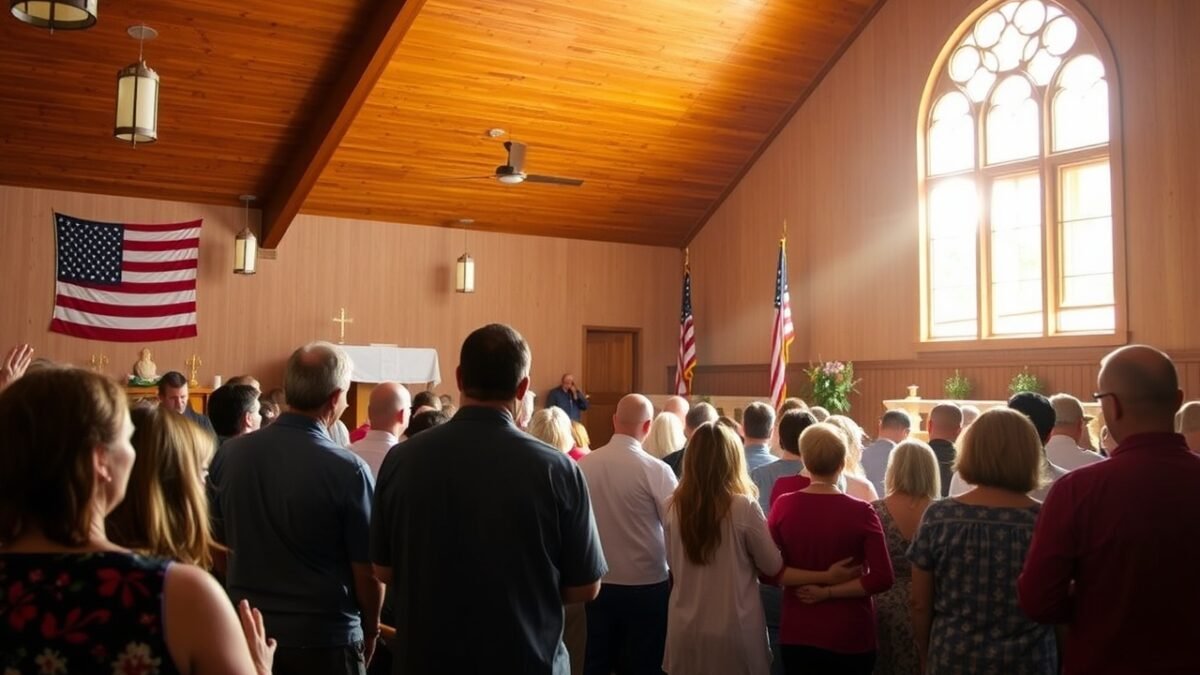
Every generation of believers has had to learn the same difficult art: how to love the land where they live without making it their ultimate home. The Israelites wept by the rivers of Babylon. The early church prayed for emperors who persecuted them. Pilgrims crossed an ocean carrying both a Bible and a hope that the two cities—the earthly and the heavenly—might somehow coexist in fruitful tension. On July 4, 2026, as the United States marks its 250th anniversary, that ancient tension is as alive as ever for American Christians.
Ivan Mesa, an elder at his local church and editor at The Gospel Coalition, captured this tension beautifully in a prayer he led his congregation in on the Sunday before America’s semiquincentennial. Read the source article. His prayer is not a political manifesto or a triumphalist anthem. It is a humble, Scripture-soaked act of intercession—giving thanks for real freedoms, confessing real failures, and longing above all for revival. It is, in short, the kind of prayer that only makes sense if Jesus is Lord and the gospel is true.
The Human Condition: Why Nations Need More Than Good Laws
Before we can pray rightly for any nation, we must see clearly what is wrong with every nation—including our own hearts. Scripture does not flatter us. The prophet Jeremiah diagnosed the root problem with surgical precision:
“The heart is deceitful above all things, and desperately sick; who can understand it?” (Jeremiah 17:9, ESV)
This is not a diagnosis reserved for political opponents or cultural elites. It is the universal condition of every person born into this world. The Apostle Paul confirms it in his sweeping indictment of humanity in Romans: “None is righteous, no, not one; no one understands; no one seeks for God” (Romans 3:10–11, ESV). The loss of Christian influence Mesa mentions in his prayer—the growing hostility toward traditional teaching, the deepening rifts between irreconcilable values—these are not primarily political problems. They are symptoms of a spiritual sickness that no election, no law, and no cultural strategy can cure at its root.
This is why the prayer Mesa led his church in is so theologically honest. He does not ask God merely to restrain evil through legislation, though he prays for that too. He asks for something far more radical: changed hearts. “We want to see changed hearts, not simply restrained actions,” the prayer declares. That distinction is everything. Laws can modify behavior; only the gospel can transform the soul.
The Answer: Jesus Christ, Lord of Every City
The good news—the euangelion, the gospel—is that God did not leave humanity to its deceitful heart. He sent his Son. The Apostle Paul, writing to a church living under the shadow of the Roman Empire, proclaimed a citizenship that transcended every earthly border:
“But our citizenship is in heaven, and from it we await a Savior, the Lord Jesus Christ, who will transform our lowly body to be like his glorious body, by the power that enables him even to subject all things to himself.” (Philippians 3:20–21, ESV)
Jesus is not merely a moral teacher whose principles might improve a nation’s character. He is the risen Lord who holds all authority in heaven and on earth (Matthew 28:18, ESV). His resurrection is the hinge of history—the event that declares, in the face of every empire and ideology, that death itself has been defeated and that a new creation has already begun.
This is the foundation beneath Mesa’s prayer. When he asks God to raise up faithful Christians in political office, law enforcement, and the judiciary, he is not asking for a theocracy. He is asking that people whose hearts have been transformed by the risen Christ would carry that transformation into every sphere of life. The Apostle Peter’s charge to first-century believers living under Caesar—”Honor everyone. Love the brotherhood. Fear God. Honor the emperor” (1 Peter 2:17, ESV)—was not a call to political quietism. It was a call to embody a different kind of kingdom, one whose King had already conquered the grave.
Living It Out: Faithful Pilgrimage in the City of Man
So what does it look like, practically, to be a citizen of two cities? Mesa’s prayer and the Scriptures it draws from suggest several concrete disciplines for disciples of Jesus in this anniversary season.
1. Pray Specifically and Persistently for Your Nation
Paul urges Timothy—and through him, every local church—to make “supplications, prayers, intercessions, and thanksgivings… for kings and all who are in high positions, that we may lead a peaceful and quiet life, godly and dignified in every way” (1 Timothy 2:1–2, ESV). This is not optional background noise. It is a primary act of Christian citizenship. Consider adopting a practice like Mesa’s church: praying for one nation each week, beginning with your own.
2. Steward Your Freedoms for Witness, Not Comfort
Religious freedom is a gift, but gifts can be squandered. Mesa’s prayer asks God to use America’s freedoms “not to lull us into complacency but to make us even more zealous witnesses for Christ.” Jesus himself said, “You are the light of the world. A city set on a hill cannot be hidden” (Matthew 5:14, ESV). The freedoms many Americans enjoy—to worship, to speak, to assemble—are extraordinary platforms for gospel proclamation. Use them.
3. Invest in Small Spheres with Eternal Significance
Most believers will never hold national office or command a large platform. But Mesa’s prayer wisely reminds us that God “often works through our small spheres of influence—our homes, our neighborhoods, our church, our city.” The kingdom of God grows like a mustard seed (Matthew 13:31–32, ESV)—small, quiet, and then suddenly vast. Faithfulness in your home, your block, your small group is not a consolation prize. It is the primary mission field.
4. Hold Your Nation with Open Hands
Paul reminds us in Acts 17:26 that God “determined allotted periods and the boundaries” of every nation. America is not eternal. No nation is. To love your country rightly is to hold it with open hands—grateful for every good gift, honest about every failure, and anchored in a hope that no election or anniversary can give or take away.
The Gospel: The Only Revival That Lasts
At the center of Mesa’s prayer—and at the center of every faithful prayer for any nation—is a longing for revival. But revival is not a cultural mood shift or a return to a golden age. True revival is what happens when the gospel of Jesus Christ breaks through hardened hearts and dead souls come alive.
Here is that gospel, plainly stated: every human being has sinned and fallen short of the glory of God (Romans 3:23, ESV). The wages of that sin is death—spiritual separation from the God who made us (Romans 6:23, ESV). But God, rich in mercy, sent his Son Jesus Christ to bear that penalty in our place. Jesus died on the cross, absorbing the wrath we deserved. He was buried. And on the third day, he rose bodily from the dead, defeating sin and death forever (1 Corinthians 15:3–4, ESV).
“For God so loved the world, that he gave his only Son, that whoever believes in him should not perish but have eternal life.” (John 3:16, ESV)
This is the revival America needs. Not better policies, though good policies matter. Not more Christian influence in culture, though that is worth pursuing. What is needed—what every human heart in every nation in every century has needed—is repentance and faith in the risen Lord Jesus Christ. New life in him. That is the only hope that outlasts anniversaries, that crosses every border, and that no government can give or take away.
So as fireworks light the sky and flags wave in the summer heat, let the church of Jesus Christ do what it has always done best: pray, witness, serve, and proclaim. The City of God is coming. And its King already reigns.