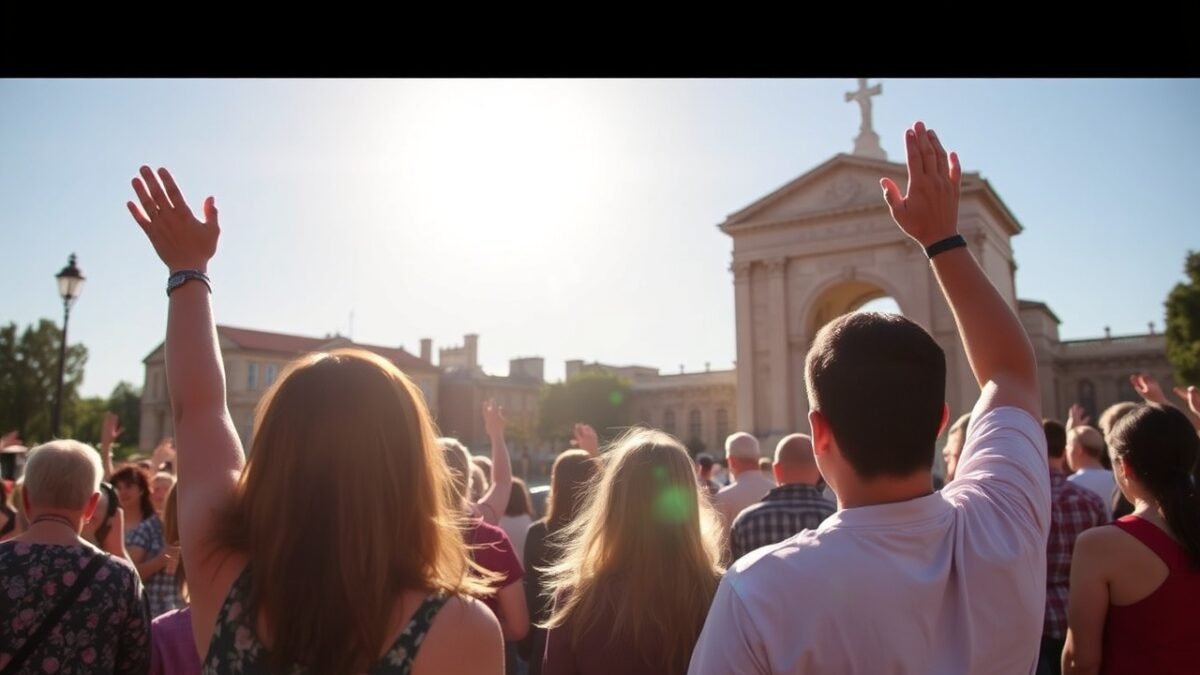
Imagine standing in the shadow of the Washington Monument on a sweltering July afternoon, sweat on your brow and a paper fan in your hand, when suddenly the air fills not with a campaign slogan or a patriotic march, but with the name of Jesus. That is exactly what happened on July 1, 2026, when the Great American State Fair dedicated a full day to “Faith, Values, and Inspiration” on the National Mall in Washington, D.C. For five hours, artists like Chris Tomlin and Maverick City Music led hundreds in worship, preachers prayed aloud, and Scripture was read in Spanish, Swahili, Italian, and Hungarian before a crowd that had gathered, perhaps half-expecting a carnival, and found a cathedral without walls. Read the source article.
Singer-songwriter Matthew West captured the moment honestly when he prayed: “Today we are reminded that we’re not just celebrating the freedom that we enjoy in this country. We’re celebrating the freedom that you offer us in a gift called grace.” That distinction matters enormously. Political freedom is precious and worth celebrating. But it is not the freedom that heals a broken heart, reconciles a prodigal to his Father, or defeats the last enemy, death. The scene on the Mall—gospel music beside a Budweiser bar, Bible verses a stone’s throw from a rodeo ring—is actually a perfect picture of the human condition: a restless people, surrounded by good things and loud distractions, still searching for the one thing that satisfies.
The Diagnosis: A Nation, Like Every Soul, Built on Something
The Rev. Samuel Rodriguez, president of the National Hispanic Christian Leadership Conference, declared boldly that America’s endurance rests on a Judeo-Christian foundation. “The pillars of this great republic are not made of marble,” he said; “they are made of Scripture.” That is a claim worth taking seriously—and Scripture itself invites us to examine what any structure is truly built upon. Jesus told a parable about exactly this:
“Everyone then who hears these words of mine and does them will be like a wise man who built his house on the rock. And the rain fell, and the floods came, and the winds blew and beat on that house, but it did not fall, because it had been founded on the rock.” — Matthew 7:24–25 (ESV)
The rock Jesus describes is not a set of civic values or even a reverence for Scripture in the abstract. The rock is obedience to His words—a living, personal relationship with the Son of God. Nations, institutions, and individual lives that are built on anything less—prosperity, ideology, tradition, or sentiment—will eventually feel the rain and the flood. The prophet Jeremiah diagnosed the human tendency to swap the living God for substitutes that cannot hold weight: “My people have committed two evils: they have forsaken me, the fountain of living waters, and hewed out cisterns for themselves, broken cisterns that can hold no water” (Jeremiah 2:13, ESV). Every generation, including ours, is tempted to carry the name of God into the public square while quietly drinking from broken cisterns.
This is not a critique of the faithful men and women who worshipped genuinely on the Mall that day. It is the universal diagnosis that Scripture makes of every human heart and every human society. We are image-bearers of God (Genesis 1:27) who have turned from our Maker (Romans 3:23), and no amount of patriotic fervor or religious pageantry can substitute for the reconciliation that only the gospel provides.
The Answer: A Name That Is Actually Above All Names
When Matthew West sang “Jesus Is King” and then asked the crowd, “How cool is it to be able to proclaim that right here, right now, today—the name above all names?”—he was, perhaps without intending a full theological lecture, pointing to the most important truth in human history. The Apostle Paul wrote:
“Therefore God has highly exalted him and bestowed on him the name that is above every name, so that at the name of Jesus every knee should bow, in heaven and on earth and under the earth, and every tongue confess that Jesus Christ is Lord, to the glory of God the Father.” — Philippians 2:9–11 (ESV)
This is not a sentiment for a summer festival. It is a cosmic declaration. Jesus is Lord not because a nation endorses Him, not because a stage is erected in His honor, and not because a video is projected on a monument. He is Lord because He is the eternal Son of God who entered human history, bore the full weight of human sin on the cross, died, was buried, and rose bodily on the third day—defeating sin and death and opening the way for every person who trusts in Him to be reconciled to God. “For God so loved the world, that he gave his only Son, that whoever believes in him should not perish but have eternal life” (John 3:16, ESV). That is the freedom Matthew West was pointing toward: not the freedom enshrined in a constitution, but the freedom purchased by the blood of Christ.
Museum of the Bible CEO Carlos Campo said he hoped the Bible could be “uniting rather than divisive.” He is right that the Bible rises above partisan criticism—but only because the Bible’s central figure, Jesus Christ, transcends every political category. He is the one in whom “there is neither Jew nor Greek, there is neither slave nor free, there is no male and female, for you are all one in Christ Jesus” (Galatians 3:28, ESV). The unity the Mall event glimpsed—Scripture read in four languages, believers from Dominican convents and Mennonite choirs standing side by side—is a foretaste of the unity that only the gospel can fully produce.
Living It Out: From the Mall to Monday Morning
Public moments of worship are gifts. They remind a watching world that Jesus is not a private preference but a public Lord. But the real test of faith is not what happens on a stage in July; it is what happens in the ordinary hours of an ordinary week. Here is how the truths proclaimed on the National Mall can take root in your daily life:
- Anchor your identity in Christ, not in country. Patriotism is a virtue, but it is not a salvation. Begin each day by confessing that your citizenship in the kingdom of God (Philippians 3:20) is your deepest and most defining identity. Pray for your nation, but worship only your King.
- Let Scripture be your actual foundation. It is easy to celebrate the Bible at a fair and neglect it at home. Commit to a daily reading plan. Let the Word of God dwell in you richly (Colossians 3:16) so that when the rains come—and they will—your house stands.
- Proclaim the name in your own sphere. Matthew West asked how cool it was to proclaim Jesus on the National Mall. It is equally powerful to proclaim His name at your kitchen table, in your workplace, and to your neighbors. You do not need a stage or a monument. You need a willing mouth and a transformed life.
- Pursue unity through the gospel, not politics. The diversity of believers at the Mall—different denominations, languages, and backgrounds—points to what the church is meant to be. Seek out fellowship across cultural and denominational lines. Let the gospel be the common ground.
The Gospel: The Only Foundation That Holds
Here is the word that every fair, every monument, and every national celebration can only gesture toward but never deliver: you are a sinner in need of a Savior, and that Savior has come. “For all have sinned and fall short of the glory of God” (Romans 3:23, ESV). The consequence of that sin is death—not merely physical, but eternal separation from the God who made you and loves you (Romans 6:23). No patriotic heritage, no religious tradition, and no public ceremony can bridge that gap.
“But God shows his love for us in that while we were still sinners, Christ died for us.” — Romans 5:8 (ESV)
Jesus Christ, fully God and fully man, lived the life you could not live, died the death you deserved, and rose from the grave on the third day, conquering sin and death forever. He offers you what no nation can: complete forgiveness, adoption into God’s family, and the certain hope of eternal life. This gift is received not by heritage or by attending the right event, but by grace through faith—“For by grace you have been saved through faith. And this is not your own doing; it is the gift of God” (Ephesians 2:8, ESV).
If you have never placed your trust in Jesus Christ, today is the day. Confess that you have sinned and fallen short. Believe that Jesus died for you and rose again. Receive Him as Lord and Savior. The freedom Matthew West sang about—the freedom of grace—is yours for the asking. And if you already know Him, let the sight of hundreds gathering to worship in the open air on a sweltering July afternoon stir your heart to fresh gratitude: the name above all names is still being proclaimed, and it is still the power of God for salvation to everyone who believes (Romans 1:16).