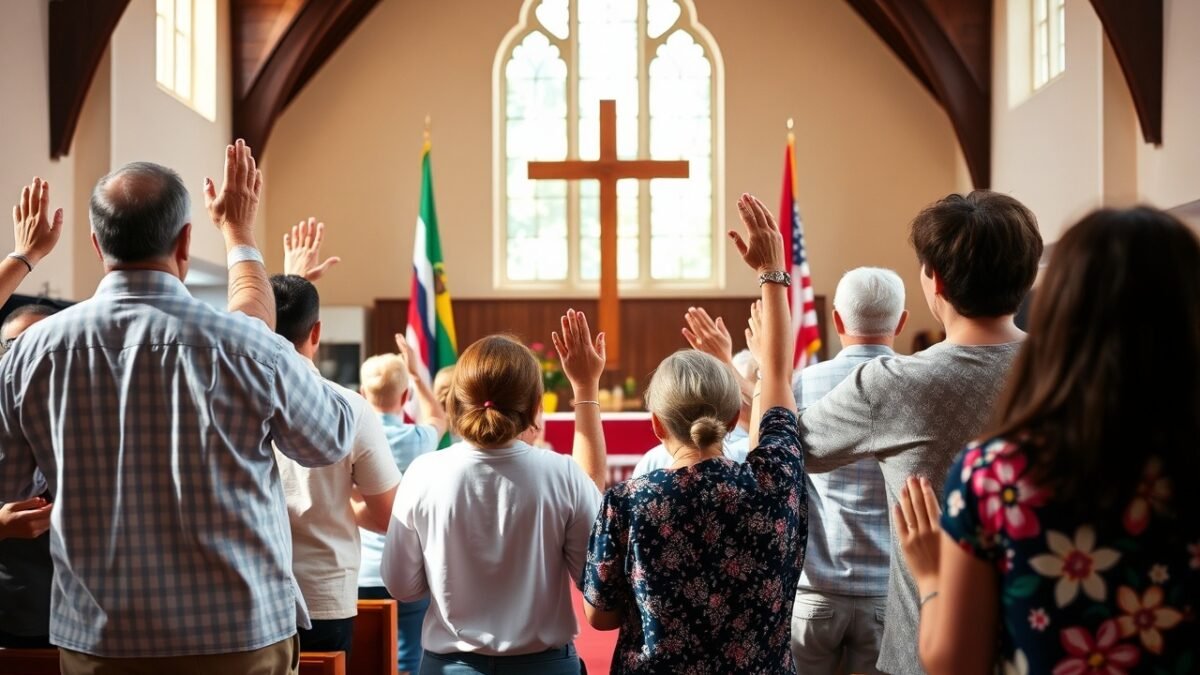
Every summer, as flags go up and fireworks fill the sky, a familiar verse rises with them: “Blessed is the nation whose God is the LORD” (Psalm 33:12, ESV). For generations of American believers, it has felt like a divine endorsement of their homeland—a word of assurance that God is on their side. And the impulse behind that feeling is not entirely wrong. Gratitude for one’s country, love of neighbor, and the desire to see a people flourish under God’s care are good and holy things.
But what if we have been reading this psalm too small? What if the blessing it announces is far larger, far more costly, and far more glorious than national prosperity or political favor? Read the source article that prompted this reflection, and then come with us deeper into the text—because Psalm 33 is ultimately not a national anthem. It is a gospel hymn.
The Human Longing Behind the Verse
We are creatures who crave belonging. We want to know that we are on the right side of history, that the community we love is secure, that the future is not chaos. This longing is not sinful in itself; it is woven into us by the God who said it is not good for man to be alone (Genesis 2:18). But sin bends that longing inward and downward. We reach for earthly kingdoms to do what only the eternal kingdom can accomplish. We ask flags and constitutions and armies to carry the weight that only a Savior can bear.
“Unless the LORD builds the house, those who build it labor in vain. Unless the LORD watches over the city, the watchman stays awake in vain.” (Psalm 127:1, ESV)
The prophet Jeremiah warned a people who had made the same mistake: they had trusted in the temple as a talisman, in national identity as a guarantee of divine favor, while their hearts wandered far from God (Jeremiah 7:4). The diagnosis is timeless. Every generation is tempted to confuse the gift with the Giver, the nation with the kingdom, the blessing with the Blesser.
What Nation Does Psalm 33 Actually Address?
Psalm 33:12 does not stand alone. Its second line is the key that unlocks the first: “Blessed is the nation whose God is the LORD, the people whom he has chosen as his heritage!” The blessed nation is not a nation that chooses God—it is a nation God has chosen. In its original context, that nation is Israel, the covenant people redeemed from Egypt, set apart as God’s treasured possession (Deuteronomy 7:6).
But the New Testament does not leave that promise locked inside one ethnic or geographic community. The apostle Peter, writing to Jewish and Gentile believers scattered across the Roman Empire, applies Israel’s covenant language directly to the church:
“You are a chosen race, a royal priesthood, a holy nation, a people for his own possession, that you may proclaim the excellencies of him who called you out of darkness into his marvelous light.” (1 Peter 2:9, ESV)
The holy nation of Psalm 33 is not bounded by a border or a constitution. It is the body of Christ—men and women from “every tribe and language and people and nation” (Revelation 5:9) who have been redeemed by the blood of the Lamb. This is not a diminishment of the psalm; it is its fulfillment. The blessing promised to Abraham’s offspring has come to all who are in Christ Jesus (Galatians 3:29).
Christ: The Blessing Himself
If we misread the nation, we will also misread the blessing. Many assume that “blessed” in Psalm 33:12 refers primarily to freedom, prosperity, and military security. Those are genuine goods, and Scripture does not despise them. But the Hebrew word ashrei—the same word behind the Beatitudes in Matthew 5—points to something deeper: a state of flourishing, of being truly well, that comes not from circumstances but from communion with God himself.
Psalm 33 praises God as the almighty Creator whose word brought the universe into being (vv. 6–9), the righteous Ruler who frustrates the schemes of nations (v. 10), and the loving Keeper of his covenant who watches over those who fear him (vv. 18–19). The apex of the psalm—verse 12—is the glad confession that this God is for us. And who is this God in his fullest self-revelation? He is the Father who sent his Son.
“He who did not spare his own Son but gave him up for us all, how will he not also with him graciously give us all things?” (Romans 8:32, ESV)
Jesus Christ is not merely the means by which we enter the blessed nation. He is the blessing. In him, all the promises of God find their Yes and Amen (2 Corinthians 1:20). The freedom, prosperity, security, and strength that Psalm 33 hints at are not finally delivered by any earthly government—they are secured by the resurrection of Jesus Christ, who has conquered sin, death, and every power that would undo us. The kingdoms of this world rise and fall; his kingdom will have no end (Luke 1:33).
Living It Out: Dual Citizens Who Sing a Better Song
So how does a believer hold love of country and love of Christ together without confusing them? Psalm 33 itself shows the way. It ends not with a political program but with a posture of trust:
“Our soul waits for the LORD; he is our help and our shield. For our heart is glad in him, because we trust in his holy name. Let your steadfast love, O LORD, be upon us, even as we hope in you.” (Psalm 33:20–22, ESV)
Pray with clarity
Pray for your nation—fervently, specifically, hopefully. Ask God for just leaders, peaceful communities, and open doors for the gospel. But anchor those prayers in the recognition that Christ, not any earthly power, is “the last best hope of earth.” Let your intercession for your country flow from your confidence in his kingdom.
Belong to the larger nation
Remember that your deepest citizenship is in heaven (Philippians 3:20). The church is not a chaplain to the state; she is an embassy of another kingdom. Worship, fellowship, and mission with believers from other backgrounds and nations—because the holy nation of 1 Peter 2:9 is gloriously diverse, and that diversity is itself a witness to the gospel’s power.
Proclaim the only lasting hope
As you celebrate your earthly homeland, do not let the noise of patriotism drown out the proclamation of the gospel. Tell your neighbors, your family, your community: there is a King whose reign will not be threatened by debt, demographic decline, or geopolitical conflict. His name is Jesus, and he is building a kingdom that cannot be shaken (Hebrews 12:28).
The Gospel: The Blessing That Endures
Here is the word every human heart needs to hear, in every nation, in every generation: we are not the people God chose because we were worthy. We are a people who wandered from God, who trusted in our own strength and wisdom, who deserved his judgment. “All have sinned and fall short of the glory of God” (Romans 3:23, ESV). No nation’s founding documents, no matter how noble, can change that verdict.
But God, rich in mercy, sent his Son. Jesus Christ—fully God, fully man—lived the life we could not live, died the death we deserved, and rose from the grave on the third day, defeating sin and death forever. He did this not for a single ethnicity or a single nation, but for all who will repent and believe. “For God so loved the world, that he gave his only Son, that whoever believes in him should not perish but have eternal life” (John 3:16, ESV).
If you have never placed your trust in Jesus Christ, this is your invitation. Turn from self-reliance and sin. Believe that he died for you and rose for you. Receive the forgiveness and new life he freely offers. And if you already belong to him, lift your voice with the psalmist—not merely as a citizen of your earthly homeland, but as a member of the holy nation that will sing his praises forever. Blessed is the people whose God is the LORD. That blessing is yours, in Christ alone.